
 n
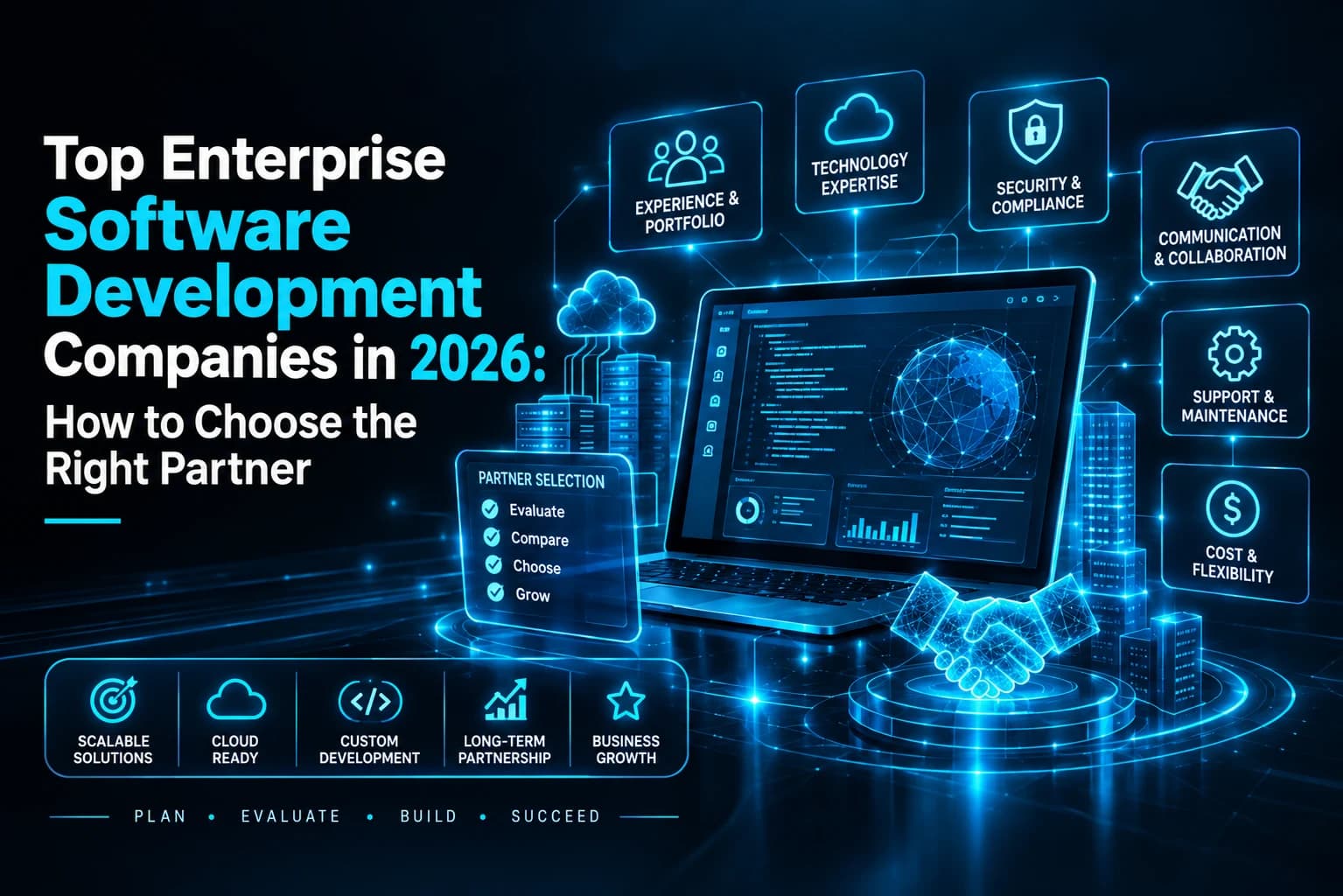
Top Enterprise Software Development Companies in 2026: How to Choose the Right Partner
Enterprise software has become an essential part of how businesses manage operations, customer relationships, financial processes, data, and internal collaboration. Choosing the right software development partner can influence project delivery, system reliability, security, and long-term operating costs. However, selecting a provider based only on company size, service lists, or marketing claims can lead to mismatched expectations. Businesses need to evaluate technical expertise, integration capabilities, delivery processes, security practices, and post-launch support before making a decision. This guide explores the major types of enterprise software development partners, the services they provide, the risks businesses should assess, and the practical steps for choosing a suitable development team in 2026.
Introduction: Why Choosing the Right Enterprise Software Development Partner Matters
Modern businesses depend on interconnected software to manage sales, customer service, inventory, finance, employee workflows, reporting, and communication. As organizations expand, these systems often become more complicated to maintain and integrate.
A business may have several applications that work independently but do not exchange information reliably. Teams may repeat manual tasks, maintain duplicate records, or struggle to obtain accurate information from different departments.
An experienced enterprise software development partner can help identify these problems and design a solution around the organization's existing technology, operational requirements, and future goals.
The right partner does more than write code. It should help clarify requirements, plan the architecture, manage implementation risks, test integrations, prepare the software for deployment, and establish a practical maintenance process.
There is no single development company that is the best choice for every business. A provider suitable for a large international transformation may not be the right fit for a growing company that needs a focused business application.
The objective is to find a team whose technical capabilities, communication style, delivery approach, and support commitments match the actual needs of the project.
What Is an Enterprise Software Development Company?
An enterprise software development company designs, builds, integrates, modernizes, or maintains software used to support business operations. Its solutions may serve individual departments, multiple business units, or an entire organization.
Unlike a simple standalone application, enterprise software often needs to connect with existing databases, customer relationship management systems, enterprise resource planning platforms, payment services, identity providers, reporting tools, and cloud infrastructure.
These systems may also require user permissions, audit records, dependable data synchronization, security controls, and the ability to support increasing workloads.
Common enterprise software projects include internal management platforms, business process automation tools, custom customer portals, inventory applications, analytics dashboards, workflow systems, and integrations between existing products.
Some organizations need a development partner to create an entirely new solution. Others need help replacing outdated software, extending an existing platform, or maintaining applications that are already critical to daily operations.
Before evaluating vendors, businesses should identify the operational problem they want to solve and determine whether they need custom development, configuration of an existing product, integration services, or a combination of these approaches.
Types of Enterprise Software Development Companies
Enterprise software providers differ in their delivery models, technical strengths, project sizes, and ongoing service capabilities. Understanding these differences makes it easier to create a relevant shortlist.
1. Custom software development companies: These teams build applications around specific business requirements, workflows, user roles, and operational processes.
2. Enterprise integration specialists: These providers connect business applications, databases, APIs, and third-party platforms so information can move between systems consistently.
3. Digital transformation consultancies: These organizations help businesses evaluate existing processes, identify technology gaps, plan modernization, and coordinate broader technology changes.
4. Cloud engineering companies: These teams help design, deploy, migrate, and operate applications on cloud infrastructure, with attention to scalability, availability, and operating costs.
5. Enterprise platform implementation partners: These providers specialize in configuring, extending, and integrating established platforms for business use.
6. Software modernization teams: These specialists improve legacy applications through refactoring, architecture changes, interface updates, cloud migration, or gradual replacement.
7. Managed application service providers: These companies provide ongoing monitoring, maintenance, incident response, technical support, and planned improvements after deployment.
8. Product engineering companies: These teams combine research, design, development, and iterative improvement to create software products that may serve customers, employees, or multiple organizations.
Some providers offer several of these services, while others focus on a narrower area. The right choice depends on the complexity of the project, internal technical resources, and the level of long-term responsibility required.
How to Evaluate Enterprise Software Development Companies
A structured evaluation process is more useful than selecting a provider based on its website, company size, or broad service claims. Businesses should assess evidence that relates directly to their intended project.
Technical expertise: Check whether the team has experience with the required programming languages, frameworks, databases, cloud services, and integration methods.
Project complexity: Review examples involving comparable workflows, data volumes, security requirements, business constraints, or legacy environments.
Integration capability: Determine whether the provider can work with the organization's current systems and explain how data will be exchanged and validated.
Delivery methodology: Understand how requirements are documented, milestones are agreed upon, changes are managed, and progress is reported.
Quality assurance: Ask about automated testing, code reviews, performance testing, security checks, and release procedures.
Security and privacy: Review authentication practices, access controls, data handling, vulnerability management, and any relevant independent assessments.
Post-launch support: Confirm who will monitor the software, resolve incidents, update dependencies, and manage future enhancements.
Communication and accountability: Identify the project lead, technical decision-makers, escalation process, and responsibilities of both parties.
Commercial transparency: Compare estimates, payment milestones, assumptions, exclusions, licensing costs, and the process for approving additional work.
Request evidence that matches the proposed team and project scope. A general portfolio may demonstrate capability, but it does not automatically establish that the same people, processes, or support arrangements will be assigned to your engagement.
| Evaluation Factor | What to Examine | Why It Matters |
|---|---|---|
| Technical Capability | Relevant frameworks, architecture, databases, and cloud experience | Helps determine whether the team can implement the required solution |
| Integration Experience | APIs, existing platforms, data migration, and synchronization | Reduces the risk of disconnected systems and inconsistent information |
| Security Practices | Access controls, encryption, testing, and incident response | Helps protect business information and reduce security exposure |
| Delivery Process | Planning, milestones, testing, reporting, and change management | Improves project visibility and expectation management |
| Ongoing Support | Maintenance plans, support hours, escalation, and service commitments | Clarifies responsibility after deployment |
| Commercial Terms | Pricing assumptions, ownership, exclusions, and change requests | Helps control costs and contractual uncertainty |
Enterprise Software Development Services Businesses Should Consider
The services offered by a development partner should align with the complete software lifecycle rather than only the initial coding stage.
Business analysis and requirements planning: Identify stakeholder needs, existing processes, operational constraints, and measurable project outcomes.
UI and UX design: Develop interfaces and workflows that help employees, administrators, customers, and other users complete tasks efficiently.
Custom application development: Build web applications, internal platforms, customer portals, administrative dashboards, and specialized business tools.
API development and integration: Connect the new application with existing software, data sources, payment services, and third-party platforms.
Cloud and infrastructure engineering: Select suitable hosting, deployment, monitoring, backup, and scaling arrangements.
Data migration and modernization: Transfer relevant information from older systems, improve data structures, and reduce dependencies on unsupported technology.
Testing and quality assurance: Validate expected functionality, access permissions, performance, integrations, and user experience.
Deployment and training: Prepare production environments, document operational procedures, and help users adopt the new system.
Maintenance and enhancement: Address defects, update dependencies, monitor system health, and introduce improvements as business needs evolve.
Not every project requires every service. A well-scoped engagement identifies which capabilities are essential, which can be added later, and which responsibilities should remain with the client's internal team.
Choosing Between a Large IT Firm and a Specialized Development Team
A common decision is whether to work with a large technology provider or a smaller specialized development team. Neither model is automatically better; each offers different advantages and trade-offs.
Large providers may be suitable for programs requiring teams across several regions, extensive delivery management, specialized departments, or long-term enterprise procurement arrangements.
Specialized teams may be a better fit for projects that need close collaboration, faster decision-making, focused technical expertise, or direct access to the people building the product.
The important distinction is not simply the number of employees. It is whether the proposed team has the skills, availability, management structure, and accountability required for the engagement.
Businesses should ask who will actually work on the project, how much access they will have to technical decision-makers, whether resources may be changed during delivery, and how knowledge will be preserved.
For a complex enterprise program, the organization may also need dedicated architecture, security, infrastructure, compliance, and operational teams. For a smaller project, a multidisciplinary team may be sufficient.
Compare the delivery model with the project's scale and risk. Avoid paying for organizational complexity that does not contribute to the intended outcome, but do not underestimate the coordination needed for mission-critical systems.
Enterprise Software Development by Business Requirement
The most useful way to shortlist providers is to begin with the problem that needs to be solved.
Custom business applications: Suitable when standard products do not support essential workflows or when a company needs a differentiated digital capability.
ERP and CRM integrations: Appropriate when departments need consistent information across sales, finance, operations, inventory, and customer service systems.
Legacy application modernization: Useful when existing software has become expensive to maintain, difficult to extend, or incompatible with current infrastructure.
Cloud-based platforms: Suitable for businesses that need flexible capacity, remote accessibility, modern deployment practices, or improved infrastructure management.
Data and reporting systems: Helpful when information is scattered across applications and decision-makers need reliable operational dashboards or analytics.
Workflow automation: Appropriate when repetitive approvals, data entry, reporting, and administrative tasks can be simplified through clearly defined processes.
Customer and employee portals: Useful when users need secure self-service access to information, requests, documents, transactions, or support.
Mobile enterprise applications: Suitable when field employees, sales teams, service professionals, or customers need secure access to business functionality on mobile devices.
A single provider may support several requirements, but the shortlist should prioritize proven experience in the specific area that carries the greatest technical or operational risk.
| Business Requirement | Potential Solution | Important Consideration |
|---|---|---|
| Disconnected business systems | API development and enterprise integration | Data consistency, access permissions, and error handling |
| Outdated internal software | Application modernization or replacement | Migration planning and service continuity |
| Manual repetitive tasks | Workflow automation | Exception handling and approval controls |
| Limited operational visibility | Reporting and analytics platform | Data quality and metric definitions |
| Growing digital demand | Cloud-enabled application architecture | Scalability, resilience, and infrastructure cost |
| Poor customer self-service | Customer portal or mobile application | Accessibility, privacy, and user adoption |
Post-Launch Support: What Happens After Deployment?
Launching an application is only one stage of its lifecycle. Once employees and customers depend on the software, reliability, monitoring, security updates, and incident handling become essential responsibilities.
Before signing a contract, businesses should determine whether the provider offers ongoing maintenance, technical support, infrastructure monitoring, incident response, and planned improvements.
Support terms should define coverage hours, severity levels, response targets, escalation contacts, reporting expectations, and the process for resolving recurring problems.
Response time and resolution time are different commitments. A provider may acknowledge an incident quickly without guaranteeing when the underlying issue will be fixed, so both terms should be understood.
Organizations should also clarify responsibility for cloud infrastructure, third-party subscriptions, backups, disaster recovery, software updates, and security vulnerabilities.
Knowledge transfer is equally important. Documentation should cover the architecture, deployment procedures, configuration, integrations, operational dependencies, and recovery processes.
If the organization expects to change providers or move maintenance in-house, the contract should address source-code access, repository ownership, credentials, documentation, and assistance during the transition.
A dependable support arrangement gives the business a clear operational model instead of leaving responsibility uncertain once the development team completes its initial work.
Security, Compliance, and Data Protection Considerations
Enterprise applications may process customer records, employee information, financial transactions, intellectual property, or confidential business data. Security requirements should therefore be established before implementation begins.
Access management: Define user roles, permissions, administrative privileges, and processes for granting or revoking access.
Data protection: Determine how information will be encrypted, stored, transferred, backed up, retained, and deleted.
Secure development: Include code reviews, dependency checks, vulnerability testing, and security validation throughout the development lifecycle.
Auditability: Identify which activities need to be logged, how long records should be retained, and who can review them.
Infrastructure security: Evaluate network controls, cloud configurations, secrets management, monitoring, and recovery procedures.
Compliance requirements: Determine which laws, contractual obligations, industry standards, or customer policies apply to the particular project.
Incident management: Establish how potential security incidents are reported, investigated, communicated, and resolved.
Certifications and independent reports can support a vendor assessment, but their scope and validity must be checked. A certificate does not automatically demonstrate that every proposed service, location, or application is covered.
The development partner and the client should document their respective security responsibilities. Security depends on implementation, configuration, operational practices, and continued review—not just a checklist of features.
Common Vendor Risks to Investigate Before Signing
Unclear project ownership: Confirm who is accountable for architecture decisions, delivery milestones, quality, and escalations.
Unverified project experience: Ask for relevant references, examples of comparable work, and details about the team's actual contribution.
Unstable staffing: Understand how the provider handles staff changes, knowledge transfer, and replacement of critical technical roles.
Unclear delivery locations: Confirm where the proposed team will work and whether the project has geographic, data-access, or contractual restrictions.
Dependence on one individual: Determine whether key technical knowledge is documented and shared across the team.
Limited source-code access: Establish repository access, intellectual property ownership, third-party license responsibilities, and delivery of project assets.
Unspecified support: Avoid relying on verbal assurances when support hours, incident priorities, and escalation processes need to be contractually defined.
Uncontrolled scope changes: Agree on how new requirements are estimated, approved, prioritized, and incorporated into the delivery plan.
Vendor lock-in: Identify proprietary components, platform dependencies, migration constraints, and the effort required to transition to another provider.
Weak recovery planning: Ask how backups, disaster recovery, continuity testing, and major service interruptions will be handled.
These risks do not automatically disqualify a provider. They identify areas that need evidence, discussion, and clear contractual terms before a long-term commitment is made.
| Potential Risk | Question to Ask | Evidence to Request |
|---|---|---|
| Staff replacement | How will the project continue if a key engineer leaves? | Knowledge-transfer and staffing procedures |
| Security gaps | How are vulnerabilities identified and handled? | Security process, test results, and applicable assessments |
| Scope changes | How are additional requirements estimated and approved? | Documented change-control process |
| Vendor dependency | Can another team maintain the application? | Source-code access, architecture documentation, and transition terms |
| Service interruption | How are critical incidents and recovery handled? | Escalation procedures and tested recovery plans |
| Unexpected costs | Which services, licenses, and activities are excluded? | Detailed estimate, assumptions, and commercial terms |
Questions to Ask Before Selecting a Development Partner
What similar projects has your proposed team delivered, and what responsibilities did it own?
How will you understand our business processes before recommending an architecture?
Which existing applications, databases, or third-party services will the solution need to integrate with?
Who will lead technical decisions, and how will disagreements about scope or architecture be resolved?
How do you estimate project timelines and manage dependencies that may be outside your control?
What testing is included for security, performance, accessibility, integrations, and user acceptance?
Who owns the source code, documentation, deployment configuration, and other project deliverables?
What support is available after launch, and which service levels will be documented in the agreement?
How will project progress, risks, budget changes, and unresolved issues be reported?
What happens if the engagement ends early or the business decides to transfer maintenance to another team?
Ask for specific examples rather than general assurances. Strong answers should explain the process, identify responsible roles, and describe how the commitment will be measured.
How Much Does Enterprise Software Development Cost?
Enterprise software development costs vary considerably because projects differ in functionality, architecture, integration complexity, security needs, user volume, and ongoing support requirements.
A focused internal application with a limited number of workflows is generally less complex than a platform connecting multiple business systems across several departments.
The largest cost factors commonly include:
Scope and functionality: The number of user journeys, workflows, permissions, reports, and business rules affects development effort.
Integration requirements: Connecting older systems or third-party platforms may require additional analysis, middleware, data mapping, and testing.
User experience: Complex role-based interfaces, accessibility requirements, and multiple device types can increase design and implementation effort.
Security and compliance: Sensitive data, audit requirements, security testing, and specialized controls may require additional work.
Infrastructure and performance: High availability, large data volumes, disaster recovery, and scaling requirements influence architecture and operating costs.
Data migration: Cleaning, mapping, validating, and transferring information from existing systems can be a substantial part of the project.
Maintenance: Monitoring, support coverage, dependency updates, and future enhancements should be included in the long-term budget.
Rather than relying on a generic price estimate, businesses should request a proposal that separates initial development, third-party costs, infrastructure, testing, deployment, and recurring support.
A phased approach can help control initial investment by delivering the highest-priority capabilities first, validating them with users, and expanding the system based on measurable results.
How to Choose the Right Enterprise Software Development Company
Step 1: Define the business outcome. Explain which operational problem needs to be solved and how success will be measured.
Step 2: Map current systems. Document existing applications, data sources, integrations, users, and technology constraints.
Step 3: Separate essential and optional features. Prioritize the capabilities required for the first release and identify improvements that can follow later.
Step 4: Create a relevant shortlist. Evaluate providers according to the technical requirements, project scale, industry context, and support model.
Step 5: Validate the proposed team. Confirm the experience, availability, responsibilities, and communication arrangements of the people assigned to the project.
Step 6: Review the technical approach. Ask how the architecture, integrations, testing, security, deployment, and future maintenance will work.
Step 7: Compare complete costs. Consider development, licenses, hosting, support, training, migration, and potential transition expenses.
Step 8: Check references and contractual details. Validate relevant project experience and review ownership, confidentiality, service levels, change control, and exit provisions.
Step 9: Agree on measurable milestones. Define deliverables, acceptance criteria, reporting arrangements, and the process for addressing delays or quality concerns.
Step 10: Plan for ongoing operations. Assign responsibility for monitoring, maintenance, backups, security updates, and future improvements before the system goes live.
This process helps organizations choose a partner based on fit and evidence rather than relying only on reputation or the breadth of a service catalogue.
Enterprise Software Development Trends in 2026
Cloud-native architecture: Businesses continue to modernize applications to improve deployment flexibility, scalability, and infrastructure management. The appropriate architecture still depends on cost, security, performance, and operational requirements.
AI-assisted business workflows: Organizations are exploring AI for search, document processing, customer support, forecasting, and internal knowledge access. Human oversight and data governance remain essential.
API-first integration: Well-defined APIs help applications exchange information and make it easier to connect new services with existing platforms.
Low-code and workflow automation: Visual development tools can accelerate suitable internal applications, although complex integrations and specialized requirements may still need conventional development.
Improved software observability: Logs, metrics, traces, and alerting help teams understand application health and investigate performance or reliability issues.
Security integrated into development: Automated checks, dependency management, secure coding practices, and continuous testing help teams identify issues earlier.
Composable enterprise systems: Businesses increasingly evaluate modular architectures that allow selected capabilities to be upgraded or replaced without rebuilding the entire platform.
Data quality and governance: Better data definitions, ownership, access controls, and validation are necessary for trustworthy reporting and AI-enabled features.
These trends should be evaluated according to business value rather than adopted simply because they are popular. A technology choice is useful when it addresses a defined requirement and can be operated reliably over time.
Why Businesses Work with Vayuzon Technology
Businesses need software solutions that reflect their operational requirements, integrate with existing systems, and remain maintainable as their needs change.
Vayuzon Technology provides software development services focused on building digital solutions around business goals, user needs, and practical technical requirements.
Custom application development: Create business applications and digital tools designed around specific workflows and organizational objectives.
Web application development: Build responsive web platforms, dashboards, portals, and business applications for desktop and mobile users.
Mobile application development: Develop mobile experiences for organizations that need to provide services or business functionality through smartphones and tablets.
Cloud and technical integration: Plan application architecture and integrations to support connectivity, deployment, and future expansion.
Ongoing improvement: Identify opportunities to refine application performance, usability, maintainability, and functionality as business requirements evolve.
Every project should begin with a clear understanding of its scope, users, systems, constraints, and expected outcomes. This helps establish realistic priorities and a development plan that aligns with the organization's available resources.
The appropriate solution may be a new application, an enhancement to an existing platform, or an integration that makes current systems work together more effectively.
Conclusion: Choose a Partner for the Entire Software Lifecycle
Selecting an enterprise software development company is a decision that affects more than the initial delivery date. It can influence system reliability, data security, integration quality, operating costs, and the organization's ability to adapt to future requirements.
Businesses should evaluate providers on relevant technical experience, delivery processes, integration capability, security practices, transparent commercial terms, and the quality of their post-launch support.
A large provider may be appropriate for a complex, multi-region program, while a focused development team may suit a business that needs direct collaboration and a clearly defined solution. The right decision depends on the work that needs to be done.
Careful requirements planning, realistic milestones, clear ownership, and a documented support model help reduce uncertainty before development begins.
At Vayuzon Technology, businesses can explore software development services tailored to their workflows, application requirements, and long-term digital goals. A clear project scope and practical technical plan provide a stronger starting point for building software that supports measurable business outcomes.
The right enterprise software development partner is not necessarily the largest company or the one with the longest service list. It is the team that understands the business problem, can work with existing technology, communicates risks clearly, and provides a practical plan for maintaining the solution after launch. By evaluating technical fit, integration experience, security, delivery accountability, and long-term support, businesses can make more informed technology decisions. Vayuzon Technology helps organizations explore software solutions aligned with their operational needs, digital strategy, and future growth.
Frequently Asked Questions
What does an enterprise software development company do?
An enterprise software development company builds, integrates, modernizes, and maintains software used to support business operations. Services may include custom applications, API integrations, cloud engineering, data migration, testing, deployment, and ongoing maintenance.
How do I choose an enterprise software development partner?
Start by defining the business problem and technical requirements. Then assess relevant project experience, integration capabilities, security practices, delivery methods, communication, pricing transparency, source-code ownership, and post-launch support.
What is the difference between enterprise software and regular business software?
Enterprise software often supports multiple departments, complex workflows, large user groups, and integrations with existing business systems. It may also require stronger access controls, auditability, availability, and ongoing operational support.
How much does enterprise software development cost?
Costs depend on scope, application complexity, integrations, security requirements, supported platforms, infrastructure, data migration, testing, and maintenance. A detailed estimate should separate initial development from recurring and third-party expenses.
How long does enterprise software development take?
The timeline depends on the number of features, stakeholder approvals, integration complexity, data migration, security testing, and deployment requirements. A phased project can release essential functionality first and expand it over time.
Why is post-launch support important?
After deployment, applications require monitoring, defect resolution, security updates, dependency maintenance, and improvements. A documented support agreement clarifies responsibilities, response expectations, escalation procedures, and ongoing costs.
Should a business choose custom software or an existing platform?
An existing platform may be appropriate when it meets most requirements with manageable configuration. Custom software is worth evaluating when important workflows, integrations, or business needs cannot be addressed effectively by available products.
What should an enterprise software development contract include?
A contract should clearly define scope, deliverables, milestones, acceptance criteria, pricing, change control, intellectual property, confidentiality, security responsibilities, support terms, and the process for transferring the software or ending the engagement.