
 n
nAI-Assisted Development and the Growing CI/CD Infrastructure Challenge
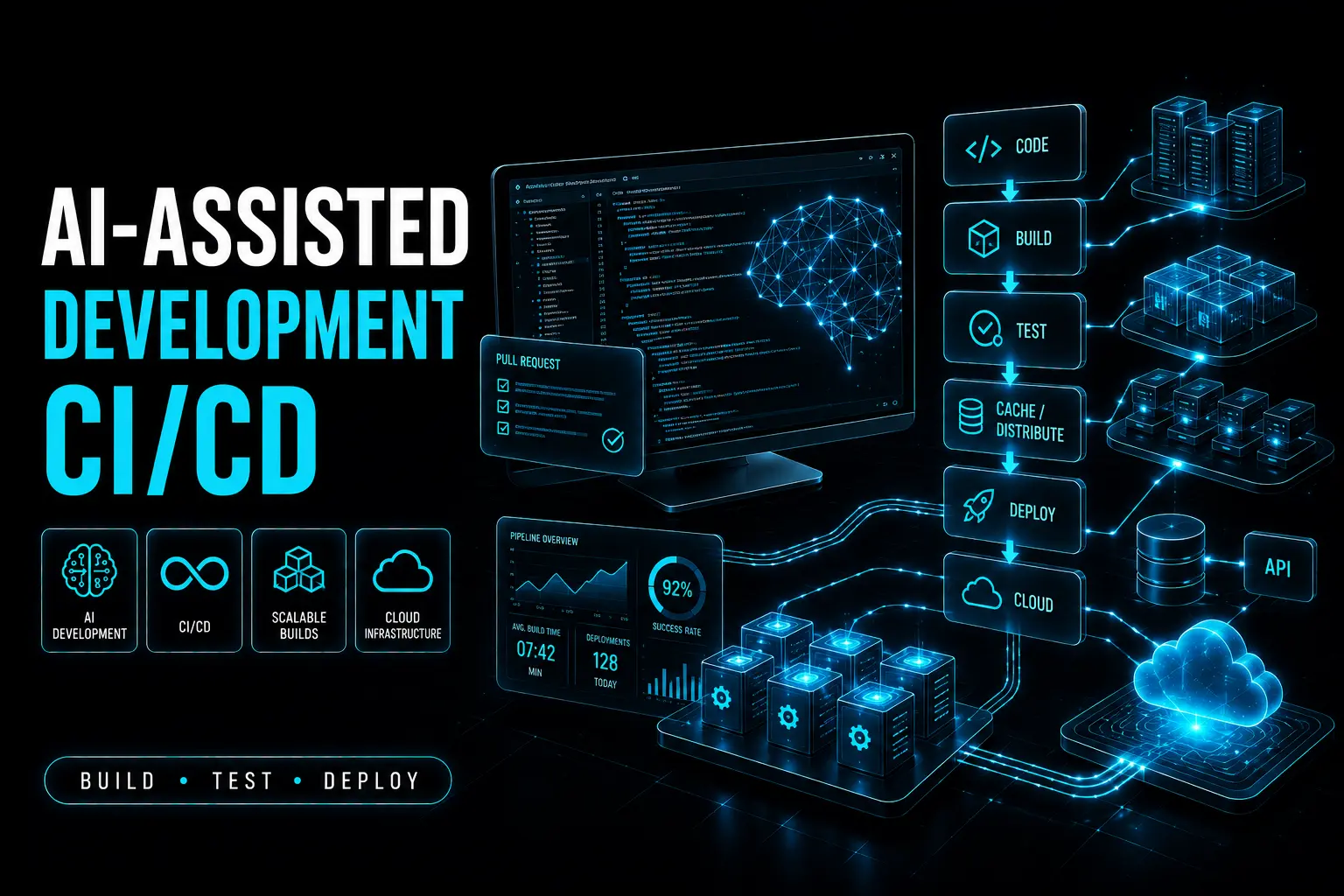
AI-assisted software development is increasing code volume and changing how development teams build, test, and deploy applications. As AI coding tools become widely adopted, CI/CD infrastructure must handle greater commit volumes, more generated code, larger test workloads, and increasingly complex development environments. Understanding build performance, delivery metrics, caching, distributed computing, and infrastructure scalability is becoming increasingly important for modern engineering teams.
Introduction
AI-assisted development has significantly changed the volume and speed at which software is produced. Developers are increasingly using AI coding tools to generate, modify, and improve code, resulting in more commits, pull requests, and automated build activity.
This increase in development velocity creates a new challenge for CI/CD infrastructure. Development pipelines that were originally designed for lower code and commit volumes may struggle to keep pace with modern AI-assisted workflows.
Increased code volume also means more testing, compilation, integration, validation, and deployment activity. As a result, build performance and infrastructure capacity are becoming increasingly important factors in software delivery.
Key Takeaways
AI-assisted development is increasing the amount of code and development activity processed through CI/CD pipelines.
Growing commit and pull-request volumes can create additional pressure on build and testing infrastructure.
Build speed is increasingly important because long build queues and compilation times directly affect developer productivity.
AI coding tools are widely adopted, but developers still report challenges with debugging and validating AI-generated code.
Caching can reduce repeated compilation and testing work by reusing previously generated results.
Distributed computing can improve build performance by spreading workloads across multiple machines.
CI/CD performance should be evaluated using both delivery speed and stability metrics rather than deployment frequency alone.
1. AI-Assisted Development and the Velocity Gap
The adoption of AI coding tools is increasing the amount of software development activity taking place across engineering organizations. Developers are increasingly using AI to generate code, create pull requests, modify existing applications, and accelerate development tasks.
As development velocity increases, CI/CD pipelines must process a larger number of changes. Every additional change can trigger compilation, testing, security checks, integration processes, and deployment workflows.
This creates a potential gap between development velocity and infrastructure capacity. When development teams generate changes faster than the pipeline can process them, build queues increase and developers spend more time waiting for feedback.
2. AI Coding Tools and the Hidden Cost of Generated Code
AI coding tools have moved beyond experimental adoption and are increasingly becoming part of everyday software development workflows.
However, widespread adoption does not mean that AI-generated code is always production-ready. Developers continue to face challenges related to code quality, debugging, correctness, and validating AI-generated solutions.
AI-generated code still needs to pass through testing, review, compilation, and deployment processes. More generated code can therefore increase the amount of work required from CI/CD infrastructure.
At scale, additional validation requirements can place greater pressure on pipelines and development teams.
3. DORA Metrics and Software Delivery Performance
Software delivery performance varies significantly between organizations. Deployment frequency and lead time can differ considerably depending on development practices, infrastructure, testing, approvals, and deployment processes.
These differences demonstrate that software delivery performance depends on more than development speed alone. CI/CD infrastructure, testing, deployment processes, organizational practices, and system architecture all influence delivery performance.
AI-assisted development should therefore be evaluated alongside the entire software delivery lifecycle rather than as an isolated productivity tool.
Deployment frequency should also not be treated as a standalone measure. Delivery performance is better understood by considering deployment frequency, lead time for changes, change failure rate, and recovery performance together.
4. Build Queue Time vs. Compute Time
When developers experience slow builds, the problem may not always be the compilation process itself. Build performance can be affected by both queue time and compute time.
A build that spends most of its duration waiting for an available build agent has a scheduling and capacity problem. A build that spends most of its time compiling and linking has a compute problem.
These problems require different solutions. Increasing compute capacity may help a compilation bottleneck, while improving scheduling and build-agent availability may help a queue bottleneck.
Organizations should therefore measure queue time and actual execution time separately before deciding how to improve CI/CD infrastructure.
5. Developer Productivity and Long Build Times
Long build times affect more than infrastructure performance. They also influence developer productivity.
When developers repeatedly wait for builds, tests, and deployment pipelines, they may switch to other tasks while waiting. This context switching can reduce concentration and increase the time required to return to the original task.
The result is a productivity cost that may not appear directly on infrastructure dashboards. Improving build performance can return productive time to engineering teams when the process is repeated hundreds or thousands of times.
6. Containerization and CI/CD Complexity
Container adoption continues to influence modern software development and CI/CD environments. Containers provide consistency and portability, but containerized build and test workflows can also introduce additional processing requirements.
Modern pipelines may need to create containers, download dependencies, execute isolated tests, build application artifacts, and push images to registries.
As development volume increases, these additional operations can contribute to overall pipeline workload. Engineering teams therefore need to consider both development velocity and the infrastructure required to support increasingly complex build environments.
7. Caching and Distributed Builds
Two important approaches to improving build performance are caching and workload distribution.
Caching avoids repeating identical work. When the same inputs produce the same output, previously generated results can be reused instead of being calculated again from scratch.
Distributed builds address a different problem. Workloads that genuinely need to execute can be distributed across multiple machines so that tasks can run in parallel rather than waiting for a single machine to become available.
Caching and distributed execution can therefore address different parts of the build-performance problem. Organizations should first identify whether repeated work, limited compute capacity, or queueing is the primary bottleneck.
8. Modern CI/CD Infrastructure Challenges
Modern engineering environments can face several infrastructure challenges as development activity increases.
Self-hosted infrastructure may struggle when developer and commit volumes increase significantly. Build-agent queues can grow, infrastructure resources can become saturated, and dependency or plugin compatibility can become more difficult to manage.
Cloud-based and ephemeral build environments introduce different challenges. Fresh build environments may have limited persistent storage, reducing opportunities to reuse cached results between runs.
Highly regulated industries can also face additional security and compliance requirements before introducing new build infrastructure or development tools.
9. Choosing and Measuring the Right CI/CD Optimization
Not every organization needs the same CI/CD optimization strategy. The appropriate solution depends on the underlying bottleneck.
If repeated compilation is the main problem, caching can reduce unnecessary work. If workloads are waiting for available compute resources, distributed execution or additional build capacity may be more appropriate.
If testing is responsible for most of the pipeline duration, optimizing test execution, parallelization, or test reliability may provide greater benefits. If deployment lead time is caused by approvals or manual processes, infrastructure optimization alone will not solve the problem.
CI/CD optimization should be measured using real engineering data. Useful measurements include build duration, queue time, compilation time, test execution time, deployment frequency, lead time for changes, change failure rate, and recovery time.
Teams should compare these measurements before and after infrastructure changes to determine whether an optimization actually improves developer productivity and software delivery.
Conclusion
AI-assisted development is changing the scale and speed of modern software engineering. As developers generate more code and development activity increases, CI/CD infrastructure must process larger volumes of compilation, testing, integration, and deployment work.
The resulting challenge is not simply a tooling problem. Engineering teams need to understand whether bottlenecks are caused by build queues, compute capacity, repeated work, testing, deployment processes, or software quality.
Caching and distributed execution can help reduce unnecessary computation and improve build performance when compute is the actual bottleneck. At the same time, organizations must continue improving testing, delivery processes, infrastructure reliability, and engineering practices.
The future of software delivery will depend on balancing AI-driven development velocity with scalable CI/CD infrastructure. Organizations that measure their delivery performance carefully and optimize the right bottlenecks will be better positioned to benefit from AI-assisted development without allowing infrastructure and build times to become a barrier to productivity.