
 n
Software Development Planning for Predictable Delivery: A Complete Guide for 2026
Successful software development requires more than skilled developers and advanced technologies. Every project needs a clear direction, realistic timelines, well-defined responsibilities, and a structured approach to managing changes. Without proper planning, even promising software projects can experience delays, unexpected expenses, unclear requirements, and repeated development work. In 2026, businesses are also dealing with AI-assisted development, cloud-based systems, increasing security expectations, and rapidly changing customer needs. These developments make effective planning more important than ever. This guide explains how to plan software projects, organize development activities, manage risks, and create a delivery process that is predictable, measurable, and aligned with business objectives.
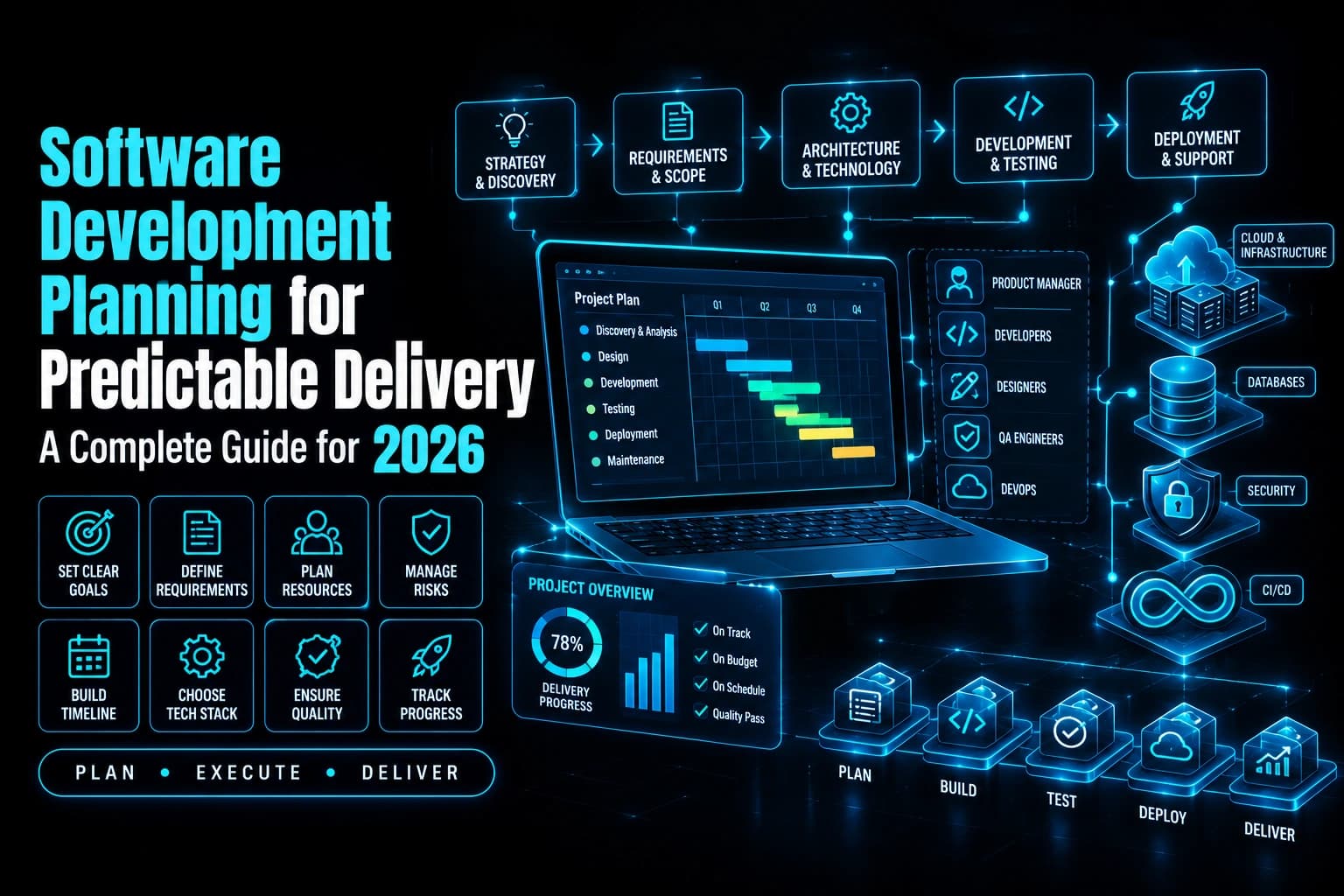
What Is Software Development Planning?
Software development planning is the process of converting a business requirement or product idea into an organized development strategy. It defines what needs to be built, why it is required, how the work will be completed, who will be responsible, and when important outcomes should be delivered.
A software development plan generally includes project objectives, requirements, technical direction, resource allocation, milestones, budget estimates, testing activities, and risk-management procedures.
Planning is not simply about preparing a calendar of development activities. It establishes the decisions and working methods that help a team move from an initial idea to a reliable software product.
A useful plan should also remain flexible. As teams learn more about the project, requirements and estimates may need to change. The purpose of planning is to manage those changes without losing control of the project's goals.
Why Is Software Development Planning Important?
Software projects involve several connected activities, including requirement analysis, design, programming, integration, testing, deployment, and maintenance. A delay or misunderstanding in one activity can affect the entire project.
Without a structured plan, developers may work with incomplete requirements, stakeholders may have different expectations, and important technical dependencies may remain undiscovered until late in development.
Effective planning helps businesses establish a shared understanding of the project before significant time and resources are invested.
Key Reasons to Plan a Software Project
Clear project direction: Everyone understands the purpose of the application, its expected features, and the outcomes the business wants to achieve.
Realistic delivery expectations: Breaking work into smaller activities helps teams estimate effort and identify possible schedule limitations.
Better resource utilization: Planning helps allocate developers, designers, testers, project managers, and infrastructure according to actual project needs.
Early risk identification: Technical dependencies, security requirements, data limitations, and integration challenges can be addressed before they cause major delays.
Controlled project scope: A defined process for reviewing new requests prevents unnecessary features from continuously expanding the project.
Improved product quality: Testing, performance requirements, documentation, and deployment preparation become part of the development process.
Stronger stakeholder communication: Regular reviews and progress updates help businesses understand what has been completed and what decisions are still required.
Benefits of a Well-Structured Software Development Plan
1. More predictable project delivery: A clear roadmap connects tasks, dependencies, resources, and milestones. Teams can identify schedule risks earlier and adjust their approach before deadlines are affected.
2. Reduced development rework: Confirming requirements and reviewing technical decisions early helps prevent teams from building features that do not match business expectations.
3. Improved budget management: Breaking the project into measurable work packages makes it easier to understand where development effort and infrastructure costs are being used.
4. Faster delivery of useful features: Prioritizing essential functionality allows businesses to release valuable features in stages instead of waiting for every planned feature to be completed.
5. Better collaboration: Defined responsibilities and communication processes reduce confusion between business stakeholders and technical teams.
6. Consistent software quality: Including code reviews, testing, security checks, and release preparation in the plan reduces the risk of last-minute quality issues.
7. Easier future improvements: Documentation and a clear technical structure make it easier to maintain, extend, and improve the application after launch.
Essential Components of Software Development Planning
A useful software development plan should cover the areas that directly influence project delivery. It does not need to be unnecessarily complicated, but it must provide enough information for the team to make decisions and track progress.
1. Business Goals and Project Objectives
Every project should begin with a clear understanding of the business problem it is expected to solve. Instead of starting with a list of features, identify the operational challenge, customer requirement, or business opportunity behind the project.
For example, a company planning a customer management platform may want to reduce manual data entry, improve lead tracking, and provide better visibility into sales activities.
Objectives should be measurable wherever possible. Examples include reducing the time required to process a request, improving order accuracy, increasing application adoption, or reducing repetitive administrative work.
Clear objectives help teams prioritize features and evaluate whether the completed software is delivering meaningful results.
2. Project Scope and Requirements
Project scope defines the features, functions, integrations, and activities included in the development engagement. It should also explain what is not included in the initial release.
Requirements can be divided into functional and non-functional categories.
Functional requirements: Describe what the application should do, such as user registration, payment processing, reporting, notifications, or document management.
Non-functional requirements: Describe how the application should perform, including security, response time, availability, accessibility, scalability, and reliability.
Requirements should be prioritized according to business value and technical importance. This helps teams distinguish essential features from improvements that can be introduced in later releases.
3. Team Structure and Responsibility Allocation
Software projects usually involve people with different responsibilities. A clear team structure ensures that important activities have accountable owners and that communication does not depend on assumptions.
Project manager: Coordinates schedules, resources, communication, risks, and overall delivery activities.
Business analyst: Understands business requirements and translates them into clear project specifications.
UI/UX designer: Plans user journeys, application layouts, prototypes, and interaction patterns.
Developers: Build application features, APIs, databases, integrations, and other technical components.
Quality assurance engineers: Verify functionality, identify defects, and evaluate whether the application meets its requirements.
DevOps or infrastructure engineers: Manage deployment environments, automation, monitoring, and operational readiness.
Team responsibilities should be documented, including who approves requirements, who makes architecture decisions, and who authorizes production releases.
4. Technology Stack and System Architecture
Technology selection influences application performance, development effort, security, maintenance, and future scalability. The technology stack should be selected according to the project's actual requirements rather than simply following popular development trends.
Planning should identify the frontend framework, backend technologies, database, APIs, cloud infrastructure, authentication approach, and third-party services required by the application.
Architecture planning should also consider how different components communicate, how information is stored, how access is controlled, and how the application will respond to failures.
For larger projects, a high-level architecture diagram can help stakeholders understand the main components and their relationships before development begins.
5. Timeline, Milestones, and Delivery Roadmap
A project timeline organizes development work into manageable stages. Each milestone should represent a meaningful result rather than simply indicating that a team has completed a number of tasks.
For example, a milestone might be the completion of an approved user-registration workflow that has been tested successfully in a staging environment.
A practical roadmap can include requirement approval, design completion, core development, integration, quality testing, user acceptance, production release, and post-launch monitoring.
Timelines should account for dependencies, stakeholder approvals, testing time, and possible delays. A schedule that includes no room for uncertainty is difficult to maintain in real projects.
6. Budget and Resource Planning
Budget planning identifies the expected cost of building, deploying, and maintaining the software. It should include more than developer salaries or initial development charges.
Project expenses may include design, development, testing, cloud infrastructure, software licences, third-party integrations, security reviews, data migration, and ongoing support.
Resource planning should also consider the availability and experience of team members. Assigning the same people to several critical tasks can create bottlenecks and affect delivery.
Businesses should review actual project effort and spending regularly against the original estimates so that financial decisions can be made before costs become difficult to control.
7. Risk Assessment and Dependency Management
Every software project has uncertainties. Some risks are technical, while others are related to requirements, business decisions, external providers, infrastructure, or team availability.
Common examples include incomplete business data, unavailable third-party APIs, changing regulations, unexpected integration complexity, security vulnerabilities, and delayed stakeholder approvals.
A risk register can record each issue, its potential impact, its likelihood, the person responsible, and the planned response.
Dependencies should also be documented. If an application relies on an external payment service or an existing business database, the team should confirm access, documentation, testing environments, and ownership before scheduling dependent work.
8. Quality Assurance and Testing Strategy
Testing should be included throughout the project rather than being postponed until development is complete. Early testing helps teams identify defects while the affected features and technical decisions are still easy to change.
Unit testing: Checks individual functions or components.
Integration testing: Verifies that connected services and application components work together correctly.
Functional testing: Confirms that application features meet documented requirements.
Performance testing: Evaluates response times, capacity, and application behavior under different workloads.
Security testing: Examines possible weaknesses in authentication, authorization, data handling, and application configuration.
User acceptance testing: Allows intended users or business stakeholders to confirm that the application supports their expected workflows.
A release should have clearly defined acceptance criteria so that teams know what must be verified before the software moves into production.
Understanding the Four P's of Software Project Management
The Four P's provide a useful way to organize the major considerations involved in software project management. They connect the human, technical, procedural, and delivery aspects of development.
The Four P's of Software Project Management
| Element | Main focus | Key considerations |
|---|---|---|
| People | The individuals involved in delivery | Skills, responsibilities, communication, collaboration, and ownership |
| Product | The software being developed | Business objectives, requirements, features, user experience, and quality |
| Process | How the work is completed | Development methodology, reviews, testing, approvals, and release procedures |
| Project | The overall delivery structure | Timeline, budget, resources, milestones, dependencies, and risks |
Popular Software Development Planning Methodologies
The development methodology determines how teams organize work, respond to changes, review progress, and deliver software. Different projects may require different approaches depending on their complexity and level of uncertainty.
Agile Development
Agile divides development into smaller iterations and encourages regular feedback from stakeholders. Teams can review working features, adjust priorities, and improve the product throughout the development process.
It is useful when requirements may evolve and businesses want to release functionality in stages. However, Agile still requires clear priorities, delivery ownership, and realistic capacity planning.
Waterfall Development
Waterfall follows a more sequential approach in which requirements, design, development, testing, and deployment are organized into defined phases.
It may be suitable for projects with stable requirements, formal approval processes, and clearly established deliverables. Changes introduced after a phase is completed can require additional effort.
Hybrid Development
A hybrid approach combines structured planning with iterative development. Teams may define overall project milestones and budget expectations while using shorter development cycles to build and review features.
This approach can be useful when businesses need formal delivery controls but also want flexibility to respond to feedback and technical discoveries.
Comparison of Software Development Methodologies
| Methodology | Approach | Best suited for |
|---|---|---|
| Agile | Iterative development with frequent feedback | Products with evolving requirements |
| Waterfall | Sequential phases with defined deliverables | Projects with stable and documented requirements |
| Hybrid | Structured milestones with iterative execution | Projects requiring both governance and flexibility |
How to Create a Software Development Plan Step by Step
A structured planning process makes it easier to move from an initial business idea to an achievable development roadmap. The following steps provide a practical starting point.
Step 1 — Understand the business requirement: Identify the problem, intended users, and expected business outcome.
Step 2 — Define the project scope: Document essential features, exclusions, technical requirements, and project constraints.
Step 3 — Identify stakeholders and responsibilities: Establish who will provide requirements, approve decisions, build the software, and manage its operation.
Step 4 — Select the development approach: Choose a suitable methodology, architecture, and technology stack.
Step 5 — Break work into manageable tasks: Organize requirements into features, user stories, development tasks, and technical dependencies.
Step 6 — Estimate effort and resources: Evaluate complexity, team capacity, infrastructure requirements, and budget.
Step 7 — Establish milestones and delivery dates: Build a realistic roadmap that includes development, testing, approvals, and deployment.
Step 8 — Identify risks and quality requirements: Record possible challenges and define the testing and security activities required.
Step 9 — Set up communication and progress tracking: Decide how teams will report progress, demonstrate completed work, and escalate issues.
Step 10 — Review and improve the plan: Update estimates, priorities, and delivery expectations as the team learns more about the project.
Tools That Help Manage Software Development Projects
Project management tools help teams organize tasks, maintain documentation, coordinate communication, and monitor delivery progress. The best tool is one that supports the team's actual working process without introducing unnecessary complexity.
Jira: Helps teams manage backlogs, sprint activities, issue tracking, and development workflows.
Azure DevOps: Supports work planning, source control, build pipelines, testing, and release management.
Trello: Provides visual boards for organizing tasks and tracking simpler workflows.
Linear: Offers issue tracking and project organization for software product teams.
Notion: Can be used for project notes, requirements, meeting records, and internal documentation.
Miro: Supports collaborative workshops, brainstorming, process mapping, and early planning.
Figma: Helps teams create wireframes, prototypes, and interface designs before development.
GitHub and GitLab: Support source code management, collaboration, code reviews, and automated development workflows.
Tools should be selected according to team size, project complexity, integration needs, and reporting requirements. A well-maintained process is more important than using a large number of platforms.
Software Development Planning Best Practices for 2026
Begin with discovery: Validate business assumptions, user needs, existing systems, and technical constraints before committing to a large development scope.
Prioritize business value: Focus on features that solve important problems and deliver measurable benefits.
Use realistic estimates: Consider task complexity, dependencies, testing, review cycles, and team availability instead of relying on optimistic timelines.
Plan for security from the beginning: Include identity management, data protection, secure coding, and vulnerability checks in the project plan.
Use AI-assisted tools carefully: AI can support coding, documentation, and testing activities, but generated output should be reviewed and validated by qualified team members.
Deliver in smaller increments: Release useful functionality in manageable stages and use feedback to improve later versions.
Maintain clear documentation: Record important requirements, architecture decisions, dependencies, and changes so that knowledge remains accessible.
Review progress regularly: Use demonstrations, milestone reviews, and delivery metrics to understand actual progress instead of relying only on status updates.
Manage changes transparently: When new requirements are introduced, evaluate their impact on cost, scope, resources, and delivery dates.
Prepare for post-launch operations: Include monitoring, maintenance, backups, user support, and future improvements in the original plan.
Common Software Development Planning Mistakes to Avoid
Starting development without clear requirements: This often leads to misunderstandings, feature changes, and avoidable rework.
Setting unrealistic deadlines: Overly optimistic estimates can create pressure, reduce testing time, and affect product quality.
Ignoring third-party dependencies: External services and existing systems can introduce delays if access and integration requirements are not confirmed early.
Adding features without reviewing scope: Uncontrolled feature requests can increase cost and extend delivery timelines.
Leaving testing until the end: Late testing makes defects more expensive to investigate and resolve.
Underestimating maintenance needs: Software requires updates, monitoring, and support after release.
Poor communication between teams: Unclear responsibilities and delayed decisions can slow down otherwise well-organized development work.
Avoiding these mistakes requires consistent planning, clear ownership, regular communication, and willingness to adjust the roadmap when new information becomes available.
How to Measure Software Project Planning Success
A project plan should be evaluated through measurable delivery and business outcomes. Tracking the right indicators helps teams understand whether the project is progressing as expected and where improvements are needed.
Milestone completion: Measures whether important project outcomes are being delivered according to the agreed roadmap.
Schedule variance: Compares actual progress with planned delivery dates.
Budget variance: Tracks differences between estimated and actual project spending.
Defect trends: Helps evaluate software quality and the effectiveness of testing activities.
Requirement completion: Measures how much of the agreed project scope has been delivered and accepted.
Deployment frequency: Tracks how regularly the team can release validated software changes.
User adoption: Evaluates whether intended users are actually using the application.
Business impact: Measures results such as reduced processing time, lower operational effort, improved accuracy, or increased customer satisfaction.
Metrics should be interpreted in context. For example, increasing deployment frequency is useful only when releases remain stable and provide value.
The Role of Communication in Predictable Software Delivery
Communication connects business stakeholders, project managers, designers, developers, and quality assurance teams. Even a technically strong project can struggle when decisions are delayed or expectations are unclear.
Teams should establish regular progress reviews, feature demonstrations, requirement discussions, and clear channels for reporting risks.
Important decisions should be documented so that everyone understands what was agreed, who approved it, and how it affects the project.
Stakeholders should also have visibility into completed work, unresolved issues, upcoming milestones, and decisions that require their input.
Open communication helps teams address challenges early and maintain a realistic understanding of delivery progress.
How VayuZon Approaches Software Development
Building useful business software begins with understanding the problem that needs to be solved. VayuZon Technology provides software development and digital solutions designed around business requirements, application functionality, and long-term growth objectives.
A structured development approach helps businesses define their requirements, identify suitable technologies, organize development activities, and prepare applications for reliable use.
Whether the requirement involves a custom business application, a web platform, a mobile application, or improvements to an existing system, planning helps establish a clear path from concept to implementation.
VayuZon also offers related technology services that support businesses in building and improving their digital presence. Explore the available services at https://www.vayuzon.com/services.
Final Thoughts
Predictable software delivery does not happen by chance. It comes from understanding business goals, defining requirements, selecting suitable technologies, organizing resources, managing risks, and maintaining consistent communication throughout development.
In 2026, software teams must also consider evolving technologies, cybersecurity expectations, cloud infrastructure, and AI-assisted engineering practices when preparing their plans.
A good development plan should provide direction without preventing teams from adapting to new information. By combining realistic planning with continuous improvement, businesses can reduce uncertainty, improve software quality, and deliver solutions that create lasting value.
A successful software project starts with a clear plan and grows through consistent execution. By defining objectives, organizing the right team, managing risks, and reviewing progress regularly, businesses can build software with greater confidence and deliver solutions that meet real operational needs.
Frequently Asked Questions
What is software development planning?
Software development planning is the process of defining project goals, requirements, scope, technology, resources, budget, timeline, responsibilities, and quality expectations before and during development.
Why is planning important in software development?
Planning helps teams understand project expectations, allocate resources, manage risks, control scope, estimate costs, and coordinate development activities. It also reduces avoidable delays and rework.
What are the main components of a software development plan?
The main components include business objectives, requirements, project scope, team responsibilities, technology architecture, timeline, budget, risk management, testing strategy, and deployment planning.
What are the Four P's of software project management?
The Four P's are People, Product, Process, and Project. They represent the team, the software being developed, the working methods, and the overall delivery structure.
What are the steps involved in software project planning?
Common steps include understanding business needs, defining scope, assigning responsibilities, selecting technologies, estimating resources, setting milestones, identifying risks, planning testing, and tracking progress.
Which methodology is best for software development planning?
Agile, Waterfall, and Hybrid approaches can all be suitable. The right methodology depends on requirement stability, project complexity, stakeholder involvement, regulatory needs, and the level of flexibility required.
Which tools are useful for software project management?
Tools such as Jira, Azure DevOps, Trello, Linear, Notion, Miro, Figma, GitHub, and GitLab can support task tracking, documentation, collaboration, design, and development workflows.
How can businesses make software delivery more predictable?
Businesses can improve predictability through clear requirements, realistic estimates, early risk identification, manageable development milestones, continuous testing, regular reviews, and transparent change management.
How does AI affect software development planning in 2026?
AI-assisted tools can support coding, documentation, testing, and project analysis. Teams should account for tool integration, output validation, data privacy, security, and additional review activities when planning AI-enabled development.
What happens if software project requirements change?
Requirement changes should be reviewed for their impact on scope, budget, resources, dependencies, and delivery dates. Approved changes should be documented and reflected in the project roadmap.