
 n
nSoftware Development Trends Shaping Businesses in 2026
Software development continues to evolve as businesses look for faster delivery, smarter automation, stronger security, and better digital experiences. In 2026, AI-first software, blockchain applications, low-code development, and progressive web apps are important technologies for organizations evaluating their digital strategies. Each offers different advantages, but successful adoption depends on business requirements, technical complexity, security, scalability, and long-term maintenance. Understanding these trends can help businesses make informed technology decisions and build solutions that deliver measurable value.
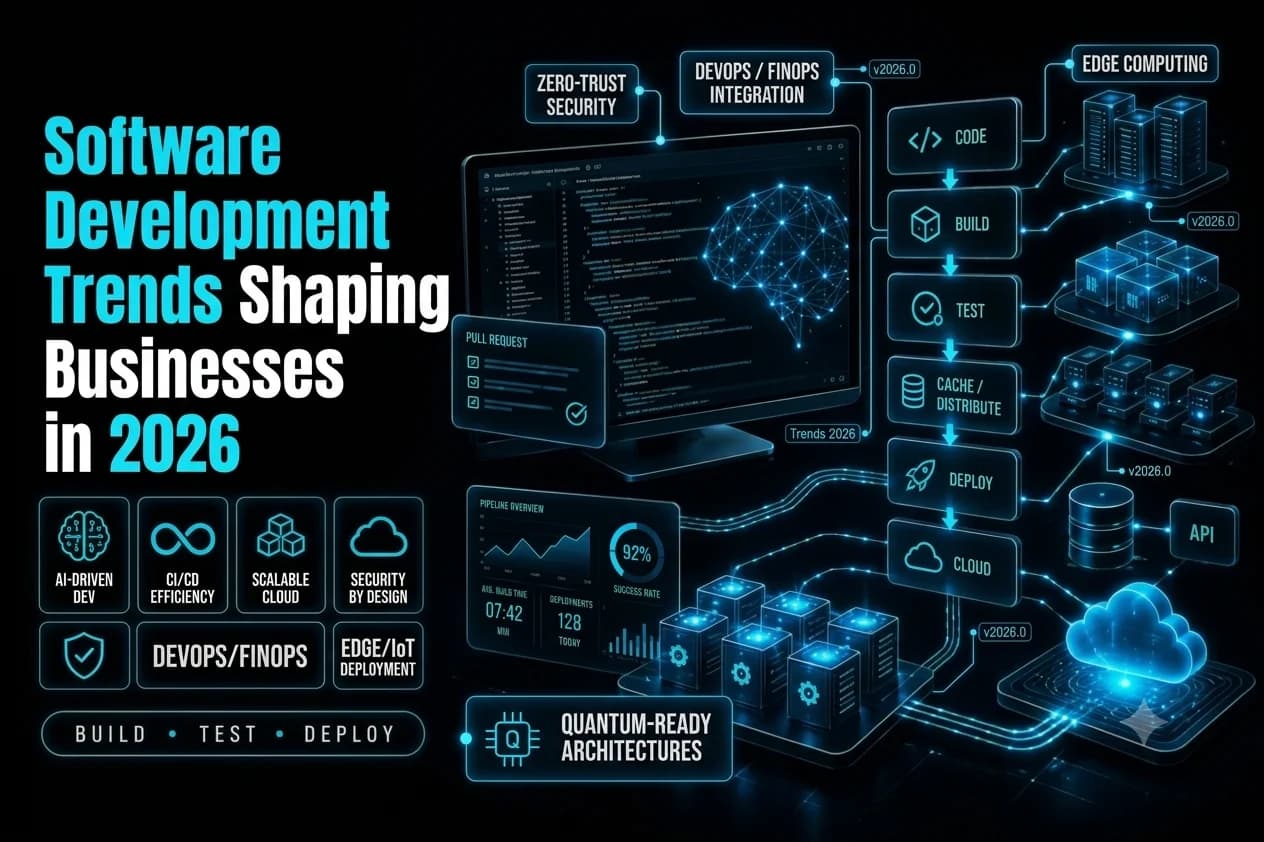
Why Software Development Trends Matter in 2026
Technology decisions directly influence how businesses operate, serve customers, manage information, and compete in changing markets. Organizations that evaluate emerging technologies carefully can identify opportunities to improve efficiency without investing in tools that do not address their actual needs.
The software development landscape is increasingly shaped by intelligent automation, flexible application architectures, faster development methods, and accessible digital experiences. These changes are helping businesses rethink how they build and maintain software.
However, adopting every new technology is not a practical strategy. The right approach is to identify business challenges first and select technologies that solve them effectively.
For example, a company looking to automate repetitive processes may benefit from AI-powered software, while a business that needs to launch an internal application quickly may consider low-code development.
The most valuable software development trend is the one that solves a real business problem while remaining practical to maintain and scale.
AI-First Software Development
Artificial intelligence is moving beyond standalone features and becoming part of the software development process and the applications businesses use every day. AI-first development places intelligent capabilities at the center of product planning, architecture, and user experience rather than adding them as an afterthought.
Modern AI-powered solutions can combine machine learning, natural language processing, computer vision, recommendation systems, and generative AI to automate tasks and help users make informed decisions.
How AI-first software benefits businesses
Automates repetitive administrative and operational tasks.
Analyzes large datasets to identify patterns and useful insights.
Provides personalized customer experiences and recommendations.
Supports conversational search, virtual assistants, and customer support.
Helps developers generate, review, test, and document code.
Identifies unusual activity and potential operational risks.
Practical use cases
In eCommerce, AI can recommend products based on relevant customer preferences and browsing behavior. In manufacturing, predictive systems can analyze equipment data to identify possible maintenance needs. In customer service, AI assistants can answer common questions and route complicated requests to human teams.
Software development teams can also use AI-assisted coding tools to accelerate routine tasks. However, generated code still requires human review, testing, security checks, and validation before production deployment.
What businesses should consider
AI systems depend on data quality, appropriate access controls, reliable integrations, and continuous evaluation. Businesses should also account for inference costs, privacy requirements, potential model errors, and the consequences of automated decisions.
AI delivers the greatest value when it improves a clearly defined workflow instead of being added simply because it is popular.
Blockchain Beyond Cryptocurrency
Blockchain is a distributed ledger technology designed to record transactions and data in a way that can be verified across participating systems. Although it became widely associated with cryptocurrency, its potential applications also include supply chains, digital identity, document verification, and selected financial and business workflows.
Blockchain is not automatically more secure or efficient than a conventional database. Its value depends on whether multiple parties need a shared, verifiable record and whether a distributed approach is appropriate for the problem.
Key benefits of blockchain technology
Shared records can improve traceability between participating organizations.
Cryptographic verification can help detect unauthorized changes to recorded information.
Smart contracts can automate predefined actions when specified conditions are met.
A common transaction history can improve accountability across business partners.
Permissioned networks can provide controlled access for approved participants.
Practical use cases
Supply chain businesses can use distributed ledgers to record product movement between manufacturers, distributors, and retailers. Organizations handling certificates or digital records can explore blockchain-based verification to make document histories easier to validate.
In selected business agreements, smart contracts can automate parts of a workflow when predefined conditions are satisfied. The underlying business process, legal requirements, and external data sources must still be designed carefully.
Challenges to consider
Blockchain implementations can introduce complexity involving transaction throughput, network governance, integration, regulatory requirements, and operational costs. Data written to a blockchain may also be difficult to correct or remove, so sensitive personal information should not be stored there without careful privacy analysis.
For many applications, a conventional database with strong access controls and audit logging remains the more practical choice.
Choose blockchain when shared verification and trust between multiple parties justify its additional complexity.
Low-Code and No-Code Development
Low-code and no-code platforms are changing how organizations create digital applications. Instead of writing every component from scratch, teams can use visual development environments, reusable components, templates, and prebuilt integrations.
Low-code platforms generally allow developers to extend visual workflows with custom code when necessary. No-code platforms focus more heavily on configuration and visual tools that enable non-developers to create simpler applications.
Why businesses are adopting low-code development
Accelerates the development of internal tools and workflow applications.
Helps teams create prototypes and validate business ideas.
Reduces repetitive coding through reusable components.
Enables faster changes to straightforward business processes.
Allows technical teams to focus on complex engineering challenges.
Practical use cases
A growing business might create an internal employee onboarding portal, an approval workflow, or a simple inventory management application using a low-code platform. A startup might use a visual development tool to validate an initial product concept before investing in a more customized solution.
Low-code tools can also help businesses automate routine operations, connect existing software systems, and build dashboards for reporting.
Limitations and risks
Not every application is suitable for low-code development. Complex business logic, specialized performance requirements, extensive customization, and strict compliance needs may require traditional software engineering.
Businesses should also evaluate platform licensing, vendor lock-in, integration limitations, security controls, data portability, and the ability to maintain applications over time.
Low-code works best when development speed and standard business workflows matter more than unrestricted architectural control.
Progressive Web Apps (PWAs)
Progressive Web Apps combine web technologies with capabilities that can make a website behave more like an application. Depending on browser and operating-system support, users may be able to install a PWA, launch it from their device, receive supported notifications, and access certain content while offline.
PWAs provide businesses with another option for delivering digital experiences without requiring a separate native application for every platform.
Key advantages of PWAs
One web application can serve users across multiple device types.
Installation can be offered directly through supported browsers.
Caching can enable offline access to selected content and features.
Updates can be delivered through the web deployment process.
Responsive layouts support different screen sizes.
A shared web codebase can reduce duplicated development effort.
Practical use cases
eCommerce businesses can use PWAs to create accessible shopping experiences. News platforms can cache selected content for reading with limited connectivity. Service businesses can provide customers with appointment booking, account access, and other web-based workflows.
PWAs can also be useful for startups that want to validate demand before investing in separate native applications.
Important technical considerations
PWA capabilities vary by browser and operating system. Background processing, notifications, hardware access, and installation behavior are not identical across platforms.
Offline functionality also requires deliberate design. Developers must determine which information can be cached safely, how stale content is handled, and how user actions are synchronized when connectivity returns.
Applications that require extensive device integration, advanced graphics, or specialized platform features may be better suited to native or cross-platform mobile development.
PWAs are a strong option when broad reach and efficient delivery matter more than access to every native device capability.
How to Choose the Right Software Development Trend
Every technology has different strengths. Selecting the right one requires an understanding of the business objective, existing systems, available skills, budget, security requirements, and expected growth.
Start with the business problem
Identify whether the priority is automation, faster application delivery, data traceability, customer engagement, or improved access across devices.
Evaluate technical fit
Assess integration requirements, expected traffic, performance, data sensitivity, platform compatibility, and the complexity of business logic.
Estimate the total cost
Consider development, hosting, licensing, maintenance, security, monitoring, training, and future migration costs rather than comparing only initial development expenses.
Build a focused proof of concept
A small pilot can help validate assumptions, reveal integration challenges, and provide early feedback before a large investment is made.
Plan for security and maintenance
Define access permissions, testing practices, update processes, monitoring, backup strategies, and ownership of the software after launch.
Measure business outcomes
Use relevant indicators such as processing time, operating costs, conversion rates, application performance, customer satisfaction, and error rates to evaluate whether the chosen technology is delivering value.
Combining Emerging Technologies for Better Results
These four trends do not need to operate independently. When their capabilities align with business requirements, they can support a broader digital strategy.
AI can help analyze information, automate workflows, and personalize user experiences. Low-code tools can accelerate the development of selected internal applications. PWAs can make digital services accessible across supported devices. Blockchain can provide shared verification in workflows where several organizations need a trusted transaction history.
For example, a supply chain application could use a PWA for access across devices, AI for demand forecasting, and conventional databases for day-to-day operational records. Blockchain might be introduced only if participating organizations need a shared, independently verifiable record of selected transactions.
The architecture should remain as simple as possible while meeting the actual requirements. Adding technologies without a clear purpose can increase costs, create integration problems, and make maintenance more difficult.
Successful digital transformation comes from combining the right capabilities, not from combining the largest number of technologies.
Common Mistakes Businesses Should Avoid
Technology adoption can become expensive when decisions are driven by hype instead of measurable needs.
Adopting AI without a clear use case
AI projects need defined objectives, suitable data, evaluation criteria, and appropriate human oversight.
Using blockchain when a database is sufficient
Distributed ledgers introduce additional design and governance considerations. A traditional database may be faster, simpler, and less expensive for applications controlled by one organization.
Relying on low-code for every requirement
Visual development platforms have limitations. Businesses should confirm that a platform supports their security, customization, integration, and scaling requirements before committing to it.
Expecting a PWA to replace every native application
PWAs are not a universal substitute for native applications. Platform-specific capabilities and user expectations should guide the decision.
Ignoring long-term maintenance
Software requires ongoing security updates, performance monitoring, dependency management, testing, and adaptation as business requirements change.
The best technology decision balances innovation with reliability, maintainability, and measurable business outcomes.
Software Development Trends Compared
The following comparison summarizes the primary strengths and considerations of each technology covered in this article.
AI-first software is useful when businesses want intelligent automation, predictive insights, or personalized experiences.
Blockchain is appropriate when multiple parties need a shared and verifiable transaction history.
Low-code development is useful for building selected business applications and workflows quickly.
Progressive Web Apps are valuable when businesses need a responsive, installable web experience across supported devices.
The final decision should be based on business requirements, technical constraints, and total ownership cost rather than popularity alone.
| Technology | Primary Benefit | Best-Fit Use Cases | Key Consideration |
|---|---|---|---|
| AI-First Software | Intelligent automation and personalization | Customer support, forecasting, recommendations, workflow automation | Data quality, model accuracy, privacy, and operating costs |
| Blockchain | Shared verification and transaction traceability | Supply chains, document verification, multi-party records | Network governance, complexity, and suitability versus databases |
| Low-Code Development | Faster development of selected applications | Internal tools, approval workflows, prototypes, dashboards | Platform limitations, licensing, security, and vendor lock-in |
| Progressive Web Apps | Broad web access and streamlined distribution | eCommerce, content platforms, service portals, booking systems | Browser compatibility and limitations on native capabilities |
Frequently Asked Questions
What are the major software development trends in 2026?
Important areas to evaluate include AI-assisted and AI-first software, low-code development, cloud-native architectures, application security, automation, and cross-platform experiences such as PWAs. Blockchain is also relevant for specific workflows requiring shared verification and traceability.
How is AI changing software development?
AI tools can assist with code generation, documentation, testing, data analysis, and user-facing features. Developers still need to validate generated outputs, address security risks, test edge cases, and ensure that applications meet production requirements.
Is blockchain useful outside cryptocurrency?
Yes. Potential applications include supply chain traceability, document verification, shared transaction records, and selected smart-contract workflows. It is most useful when multiple participants need a verifiable record and a distributed approach is justified.
What is the difference between low-code and no-code development?
Low-code platforms combine visual development with opportunities for custom coding, while no-code platforms emphasize configuration and prebuilt components for users who want to build applications with minimal programming. Both have limitations depending on the application's complexity.
Are progressive web apps better than native mobile apps?
Neither is universally better. PWAs can simplify distribution and support multiple devices through a shared web application. Native apps may be preferable when deep operating-system integration, specialized hardware access, or advanced platform-specific performance is essential.
Which software development trend is best for startups?
The right choice depends on the product. AI can automate selected workflows, low-code platforms can help validate ideas, and PWAs can provide broad web access. Startups should choose based on their target users, budget, technical requirements, and growth plans.
How can businesses reduce software development costs?
Businesses can prioritize essential features, reuse suitable components, automate testing and deployment, choose managed infrastructure where appropriate, and validate ideas through small pilots. They should also account for security and maintenance costs instead of focusing only on the initial build.
How should a company prepare for emerging software technologies?
Begin with a clear business objective, assess existing systems and skills, review security and compliance requirements, run a focused proof of concept, and measure results before expanding implementation.
Four Questions to Ask Before Investing in New Technology
Before choosing a software development approach, businesses should answer four important questions.
What specific business problem are we trying to solve?
Does the technology fit our existing systems, data, and security requirements?
What are the total development, infrastructure, licensing, and maintenance costs?
How will we measure success after implementation?
When technology decisions are connected to business goals, organizations can innovate with greater confidence and build software that remains useful as their needs evolve.