
 n
nFuture-Proofing Your Business with Custom Software Solutions
Custom software empowers businesses to adapt quickly to evolving market trends and customer needs. Unlike generic solutions, it is built to match specific workflows, improving productivity, scalability, and data security. With tailored software, organizations can automate processes, reduce operational costs, enhance customer satisfaction, and maintain a competitive advantage while supporting future growth and innovation.
Introduction
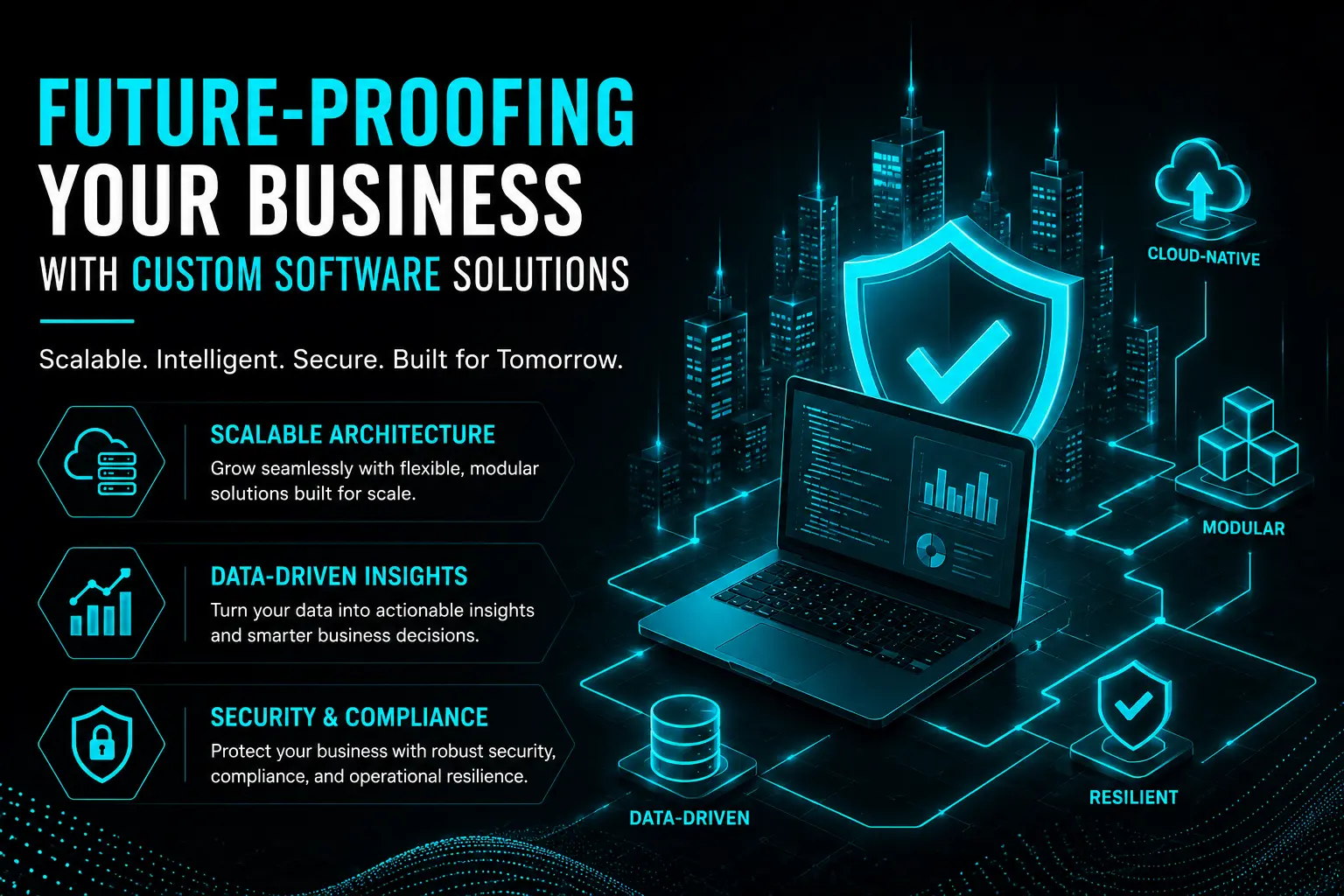
In an era where technology evolves faster than business plans, companies that depend on off-the-shelf tools risk falling behind. Custom software solutions provide a strategic advantage by aligning technology with business processes, improving scalability, and enabling rapid adaptation to market shifts. This article explains how bespoke software future-proofs your organization, highlights three core areas to prioritize—scalability and architecture, data-driven decision-making, and security and compliance—and offers practical next steps to get started.
1. Scalability and Flexible Architecture
As customer demand and feature complexity grow, rigid systems create bottlenecks and inflate costs. Custom software built with scalable architecture—microservices, cloud-native design, and modular components—lets you add capacity, swap modules, and integrate new services without full rewrites. This flexibility reduces downtime and total cost of ownership while enabling continuous delivery of features. For fast-moving businesses, designing with APIs and containerization ensures new channels, partners, or regions can be onboarded quickly, keeping your product competitive as usage patterns change.
2. Data-Driven Decision Making
Custom solutions let you capture, centralize, and analyze the exact data points your business needs rather than shoehorning operations into generic analytics. Tailored data pipelines, event tracking, and dashboards convert raw metrics into actionable insights—improving customer retention, optimizing pricing, and identifying new revenue streams. By embedding real-time analytics and machine-learning-ready pipelines, bespoke software empowers teams to test hypotheses, automate routine decisions, and personalize user experiences at scale, turning data into a measurable strategic asset.
3. Security, Compliance, and Operational Resilience
Security and regulatory requirements vary across industries and jurisdictions. Prebuilt tools often include unnecessary features or lack required controls, creating risk or inefficiency. Custom software allows you to enforce principle-of-least-privilege access, implement industry-specific encryption and audit trails, and automate compliance reporting. Building resilience—redundancy, automated failover, and observability—protects uptime and customer trust. Investing in security-first architecture and continuous security testing helps prevent costly breaches and ensures that your systems can adapt to new regulation or threat landscapes.
Conclusion
Future-proofing requires more than reactive patching; it demands software that scales, leverages your data, and protects operations. Custom software delivers these capabilities by aligning technology with business goals and embedding adaptability into the product’s core. Start by auditing your most critical processes, defining measurable outcomes (scalability targets, key metrics, compliance needs), and partnering with an engineering team experienced in cloud-native, data-centric, and secure design. That structured approach turns software from a constraint into a strategic enabler for long-term growth.