
 n
6 Emerging Technologies Transforming Businesses in 2026
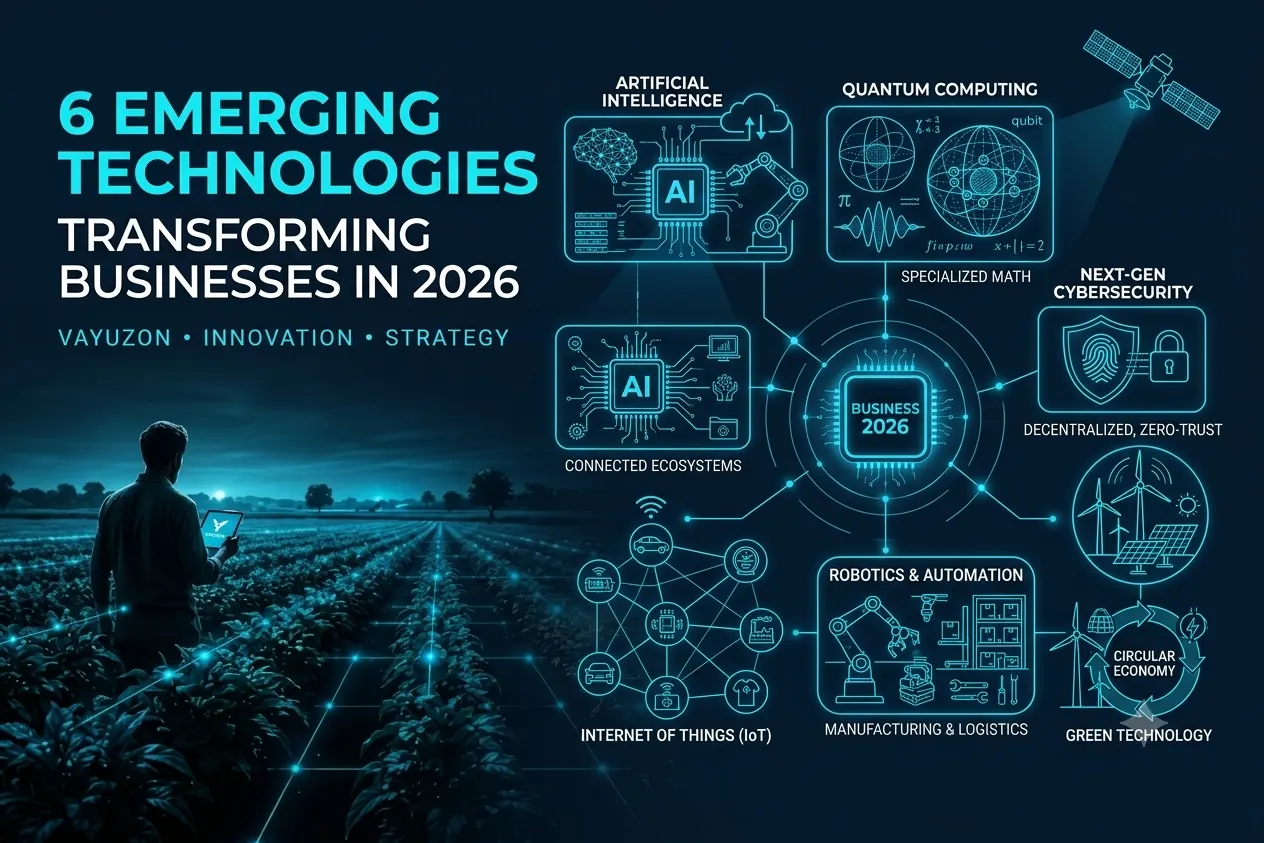
Emerging technologies are changing how businesses operate, compete, and deliver value. In 2026, artificial intelligence, connected systems, advanced cybersecurity, robotics, quantum computing, and green technology are creating new opportunities for organizations across industries. Understanding these developments can help business leaders make informed investments, improve operational efficiency, strengthen resilience, and discover new sources of growth. This article explores six important technology trends, their practical business applications, and the strategies organizations can use to adopt them responsibly.
Introduction: Why Emerging Technologies Matter in 2026
Business technology is evolving at a pace that makes yesterday's innovations today's operational requirements. Artificial intelligence is supporting everyday decisions, connected devices are delivering real-time operational data, and automation is helping organizations improve productivity across complex workflows.
The shift from experimentation to practical implementation is becoming increasingly important. Businesses are no longer evaluating technology only for its novelty. They are assessing whether it can reduce costs, improve customer experiences, strengthen security, accelerate product development, and create measurable business value.
However, adopting every new tool is not a winning strategy. Organizations need to understand the maturity, cost, risks, and long-term relevance of each technology before investing. A clear strategy helps businesses distinguish promising opportunities from short-lived hype and turn innovation into sustainable competitive advantage.
What Is an Emerging Technology?
An emerging technology is an innovation that is developing rapidly and has the potential to significantly change existing products, services, business processes, or industry structures. Some technologies are still in research and development, while others are already being implemented by organizations seeking better performance and new capabilities.
Emergence is not determined by novelty alone. It also depends on improvements in technical capability, commercial viability, investment, market demand, infrastructure, and the ability to integrate technology into real-world operations.
For businesses, the value of an emerging technology depends on how effectively it addresses a genuine problem. Organizations must also consider employee readiness, data quality, regulatory obligations, integration requirements, and the impact on customers and partners.
1. Artificial Intelligence Beyond Basic Automation
Artificial intelligence has progressed beyond simple rule-based automation. Modern AI systems can analyze large datasets, generate content, summarize documents, assist with software development, identify patterns, and support complex decision-making.
Generative AI and AI-powered assistants are expanding the ways employees interact with business information. Teams can use these tools to draft proposals, explore product concepts, analyze customer feedback, prepare reports, and accelerate repetitive knowledge-based tasks. Agentic AI systems are also attracting attention because they can coordinate multiple steps toward a defined objective, subject to appropriate permissions and human oversight.
Practical business applications include:
Content and product development: Generate initial concepts, drafts, design variations, and prototypes for human review.
Customer experience: Support personalized recommendations, faster service responses, and more relevant customer interactions.
Workforce productivity: Help employees research information, summarize meetings, analyze documents, and write or review code.
Business intelligence: Identify patterns in operational data and help teams explore forecasts, scenarios, and potential risks.
AI adoption also introduces important challenges, including inaccurate outputs, privacy concerns, intellectual property questions, bias, and security risks. Organizations should establish data controls, evaluation processes, clear usage policies, and human review for consequential decisions.
The biggest opportunity is not simply replacing existing tasks. It is redesigning workflows so people and AI can work together to improve the quality, speed, and consistency of business outcomes.
2. Quantum Computing and Advanced Problem-Solving
Quantum computing uses principles of quantum mechanics to process information in ways that differ from conventional computing. While traditional computers represent information using bits, quantum systems use quantum bits, known as qubits.
Quantum technology is still developing, and broad commercial adoption remains uncertain. Nevertheless, research and experimentation are progressing in areas where conventional computing faces difficult computational challenges.
Potential applications include:
Drug discovery and chemistry: Explore molecular behavior and support research into complex chemical interactions.
Financial services: Investigate optimization techniques and specialized approaches to risk analysis.
Logistics and manufacturing: Research new ways to approach scheduling, routing, and complex resource allocation.
Materials science: Support the investigation of materials with potentially useful electrical, chemical, or energy properties.
Businesses should distinguish current experimental capabilities from future possibilities. Many proposed applications still require further technical advances, and quantum computers are not universally faster or better than classical systems.
For most organizations, a practical preparation strategy includes tracking industry developments, identifying computationally difficult business problems, building partnerships where relevant, and strengthening quantum-related skills without overcommitting budgets to immature solutions.
3. Next-Generation Cybersecurity and Digital Resilience
As organizations expand their use of cloud platforms, AI applications, connected devices, and digital services, their exposure to cyber threats also grows. Cybersecurity must therefore be treated as a business-wide responsibility rather than a task limited to the IT department.
Modern security strategies focus on preventing attacks, detecting suspicious activity, limiting damage, and restoring operations quickly. The objective is not only to protect systems but also to preserve customer trust and business continuity.
Important developments include:
AI-assisted threat detection: Analyze security events and identify unusual patterns that may indicate an attack. AI-generated alerts still require validation to reduce false positives and missed threats.
Zero-trust security: Verify access requests continuously using identity, device, context, and policy signals rather than automatically trusting users inside a network.
Post-quantum cryptography: Prepare cryptographic systems for future threats from sufficiently capable quantum computers by assessing migration requirements and adopting suitable standards.
Automated incident response: Speed up investigation, alert prioritization, containment, and recovery through carefully controlled security workflows.
Cyber resilience also depends on regular software updates, employee awareness, strong identity management, tested backups, vendor risk assessments, and incident-response exercises.
Businesses that build security into product design and daily operations are better positioned to reduce disruption and maintain confidence among customers, employees, and partners.
4. Internet of Things and Intelligent Connected Ecosystems
The Internet of Things, or IoT, connects physical objects such as industrial machines, vehicles, meters, sensors, and wearable devices to systems that collect and exchange data. These connected environments provide businesses with greater visibility into their assets, processes, and operating conditions.
IoT becomes especially valuable when real-time data is combined with analytics, AI, and automated workflows. Instead of waiting for a problem to appear, organizations can identify warning signs and take action earlier.
Common business applications include:
Smart manufacturing: Monitor equipment conditions, identify performance anomalies, and plan maintenance before failures interrupt production.
Retail and inventory: Track stock movement, monitor storage conditions, and improve replenishment decisions.
Healthcare: Support remote monitoring and provide care teams with additional information, subject to appropriate privacy and clinical safeguards.
Transportation and logistics: Track vehicles, shipments, temperature conditions, and delivery progress.
Energy management: Measure consumption and identify opportunities to reduce waste across buildings and facilities.
Successful IoT deployments require dependable connectivity, secure device management, reliable data pipelines, and interoperability between different systems. Organizations should also plan for device replacement, ongoing maintenance, and the protection of sensitive operational information.
When connected ecosystems are designed well, they help businesses move from reactive operations toward more informed, predictive, and responsive decision-making.
5. Robotics, Intelligent Automation, and Human-Machine Collaboration
Robotics is expanding beyond traditional industrial assembly lines. Advances in sensors, machine vision, AI, and control systems are helping robots perform a wider range of repetitive, precision-based, and physically demanding tasks.
Businesses are exploring robotics in warehouses, agriculture, healthcare, manufacturing, inspection, and logistics. Software-based automation is also helping organizations process documents, manage routine transactions, and coordinate digital workflows.
Key opportunities include:
Operational efficiency: Automate repetitive tasks, improve process consistency, and support production at scale.
Workplace safety: Use robots for selected hazardous, physically demanding, or difficult-to-access activities.
Quality control: Apply machine vision and automated inspection to identify defects and improve consistency.
Warehouse and logistics operations: Support sorting, picking, movement of goods, and inventory processes.
Service delivery: Explore robotic assistance for selected hospitality, healthcare, and customer-support activities.
The business case depends on more than the purchase price of a robot. Organizations should evaluate integration costs, safety requirements, maintenance, employee training, workflow redesign, and the time required to achieve a return on investment.
Human-machine collaboration is particularly important. Employees may need to transition from repetitive manual tasks toward supervision, exception handling, technical maintenance, and higher-value problem-solving. Successful automation strategies invest in people alongside machines.
6. Green Technology and Climate-Focused Innovation
Green technology uses innovation to reduce environmental impact, improve resource efficiency, and support more sustainable ways of producing and delivering goods and services. As energy costs, climate risks, customer expectations, and reporting requirements evolve, sustainability is becoming a strategic consideration for many organizations.
Green innovation extends beyond renewable energy. It also includes energy storage, electrification, carbon measurement, efficient buildings, sustainable materials, water management, and circular production models.
Important areas of development include:
Renewable energy and storage: Improve the use of solar and wind power through storage technologies, smarter energy management, and more flexible grids.
Carbon measurement and management: Track emissions, identify reduction opportunities, and improve the quality of climate-related data.
Precision agriculture: Combine sensors, connected equipment, and analytics to optimize irrigation, fertilizer use, and crop management.
Circular materials: Design products and packaging for reuse, repair, recycling, and reduced material waste.
Energy-efficient infrastructure: Improve building controls, data-center efficiency, and industrial energy consumption.
Organizations should also monitor applicable environmental regulations and sustainability disclosure requirements in the jurisdictions where they operate. Requirements differ by country, company size, industry, and regulatory status, so businesses should verify current obligations rather than rely on general assumptions.
Green technology can create business value through lower resource consumption, improved operational efficiency, stronger supply-chain resilience, and new sustainable products. The most effective initiatives combine measurable environmental outcomes with a credible commercial case.
Why These Six Emerging Technologies Deserve Business Attention
These technologies differ in maturity, investment requirements, and potential impact. Together, however, they illustrate how business operations are becoming more intelligent, connected, automated, secure, and resource-conscious.
They can reshape industries: AI changes knowledge work and product development, IoT connects physical operations to digital systems, and robotics expands automation into new environments. Quantum computing may eventually advance specialized research, while green technologies are influencing energy and resource strategies.
They can strengthen competitive advantage: Organizations that solve real customer problems with the right technologies may improve service quality, reduce operational friction, accelerate innovation, and create differentiated products.
They demand a stronger approach to risk: Greater digital capability also introduces concerns involving privacy, cyber threats, system reliability, workforce disruption, and regulatory compliance.
They require evidence rather than hype: A promising technology is not automatically the right investment. Pilot results, total cost of ownership, measurable outcomes, integration complexity, and operational readiness should guide decisions.
The central question for business leaders is not which technology is most fashionable. It is which technology can produce a meaningful and sustainable improvement in their particular business.
How Businesses Can Prepare for Emerging Technologies in 2026
Adopting emerging technologies successfully requires a structured approach that connects innovation with business priorities. Organizations should begin with clearly defined problems and measurable outcomes instead of investing in technology simply because it is new.
1. Identify high-value business challenges: Examine customer pain points, operational bottlenecks, recurring costs, security weaknesses, and opportunities for new services.
2. Assess technology readiness: Compare available solutions based on maturity, reliability, implementation complexity, vendor support, and compatibility with existing systems.
3. Establish measurable goals: Define indicators such as processing time, defect rates, customer satisfaction, energy use, system availability, or cost per transaction.
4. Start with controlled pilots: Test solutions in a limited environment, document results, evaluate risks, and gather feedback before expanding deployment.
5. Build data and security foundations: Improve data quality, access controls, privacy practices, integration architecture, monitoring, and recovery procedures.
6. Develop employee capabilities: Provide practical training and help teams understand how their roles, responsibilities, and workflows may change.
7. Create clear governance: Assign accountability for investment decisions, AI usage, cybersecurity, compliance, supplier selection, and ongoing performance reviews.
8. Scale based on evidence: Expand successful projects only when the business case, operational controls, and long-term support model are sufficiently strong.
A phased strategy enables organizations to experiment without losing control of cost, risk, and business continuity.
Common Challenges When Adopting Emerging Technologies
Budget and return on investment: New systems can require significant spending on licenses, infrastructure, integration, training, and maintenance. Establish a realistic total-cost estimate before committing to large deployments.
Skills shortages: Teams may need additional expertise in AI, cybersecurity, robotics, data engineering, or sustainability reporting. Training and specialist partnerships can help close gaps.
Legacy system integration: Older applications and fragmented data can make implementation more difficult. A clear architecture and staged modernization plan can reduce disruption.
Privacy and security: New tools may introduce additional data flows, external dependencies, and attack surfaces. Security and privacy reviews should be part of procurement and design.
Uncertain maturity: Some technologies have impressive demonstrations but limited proven value in everyday business environments. Validate claims through controlled tests and independent evaluation.
Change resistance: Employees may worry about new workflows or job responsibilities. Transparent communication, participation, and practical training can improve adoption.
Regulatory complexity: Legal and reporting requirements vary by market and industry. Organizations should consult qualified experts when decisions have significant compliance implications.
Emerging Technology Comparison for Business Leaders
The following comparison provides a practical starting point for evaluating the six technology areas. Actual readiness and return on investment depend on the use case, sector, implementation environment, and organizational capabilities.
| Technology | Potential Business Value | Key Consideration |
|---|---|---|
| Artificial Intelligence | Knowledge productivity, analytics, personalization, and content generation | Data quality, accuracy, privacy, and human oversight |
| Quantum Computing | Potential advances in specialized simulation and optimization | Early maturity, technical limitations, and uncertain commercial timelines |
| Next-Generation Cybersecurity | Reduced security exposure and stronger business resilience | Continuous monitoring, governance, and implementation discipline |
| Internet of Things | Real-time visibility, predictive maintenance, and resource monitoring | Device security, connectivity, and data integration |
| Robotics and Automation | Higher consistency, operational efficiency, and safer task execution | Integration costs, safety, maintenance, and workforce readiness |
| Green Technology | Resource efficiency, emissions reduction, and sustainable innovation | Measurement quality, project economics, and applicable regulations |
The Future of Business Innovation: Combining Technology With Strategy
The greatest opportunities often emerge when technologies work together. AI can interpret data from connected devices, IoT platforms can provide visibility into operations, and robotics can act on insights by carrying out selected physical tasks. Cybersecurity helps protect these interconnected systems, while green technology can make their operation more resource-efficient.
However, combining technologies also increases complexity. Organizations need a coherent architecture, reliable data, secure integration, accountable decision-making, and clear ownership of business outcomes.
Technology strategy should therefore be treated as an ongoing business capability rather than a one-time implementation project. Regular reviews of customer needs, industry changes, operating performance, and emerging risks can help organizations adjust their priorities as conditions evolve.
Businesses that pair experimentation with strong execution are better placed to translate technological progress into reliable products, improved services, and long-term value.
| Implementation Stage | Recommended Action | Expected Outcome |
|---|---|---|
| Discover | Identify business challenges and suitable technology opportunities | Prioritized list of potential use cases |
| Evaluate | Assess feasibility, risk, cost, and operational readiness | Evidence-based investment decision |
| Pilot | Test the solution against predefined success metrics | Validated performance and lessons learned |
| Deploy | Integrate the solution with workflows and governance controls | Operational use with clear accountability |
| Optimize | Monitor outcomes, collect feedback, and improve continuously | Sustained value and better long-term performance |
Conclusion: Turn Emerging Technology Into Business Opportunity
Artificial intelligence, quantum computing, advanced cybersecurity, IoT, robotics, and green technology each offer distinct opportunities to rethink how businesses operate and compete. Some are already delivering practical value across industries, while others remain at earlier stages of commercial development.
The right approach is to evaluate each opportunity against business objectives, readiness, cost, security, and measurable impact. Small experiments, strong governance, employee development, and continuous evaluation can help organizations innovate while managing uncertainty.
In 2026, success will not come from adopting the largest number of technologies. It will come from selecting the right capabilities, implementing them responsibly, and continually improving how people, processes, and systems work together.
At Vayuzon Technology, businesses can explore digital solutions that align technology decisions with practical business goals, from software development and cloud-based systems to scalable digital experiences.
Emerging technology creates the greatest value when innovation is connected to a clear business purpose. By evaluating opportunities carefully, investing in people and secure infrastructure, and measuring real-world outcomes, organizations can build a more adaptable and competitive business for the years ahead.
Frequently Asked Questions
What are the most important emerging technologies for businesses in 2026?
Key areas to monitor include artificial intelligence, quantum computing, advanced cybersecurity, the Internet of Things, robotics and automation, and green technology. Their relevance depends on an organization's industry, goals, budget, and technology readiness.
Which emerging technology can deliver business value most quickly?
AI-enabled productivity tools, cybersecurity improvements, and targeted IoT or workflow automation projects may deliver value relatively quickly when they address a clear business problem. Results depend on implementation quality, data readiness, and how success is measured.
Is quantum computing ready for widespread business adoption?
Not yet for most general business workloads. Quantum computing is progressing through research and specialized experimentation, but practical advantages remain use-case dependent. Businesses can monitor developments and assess relevant problems without assuming immediate commercial benefits.
How can small and medium-sized businesses adopt emerging technologies?
SMBs can start with focused use cases, managed cloud services, established AI tools, stronger cybersecurity practices, and small automation projects. Piloting solutions before scaling helps control costs and establish measurable results.
What risks should businesses consider before adopting new technology?
Important risks include cybersecurity threats, privacy violations, inaccurate AI outputs, integration challenges, vendor dependence, skills shortages, uncertain returns, and changing regulatory requirements. Risk assessments and governance should be built into implementation plans.
How can organizations measure the success of technology adoption?
Organizations should establish baseline metrics and track relevant indicators such as operating costs, processing time, productivity, customer satisfaction, error rates, system availability, energy consumption, and risk reduction.