
 n
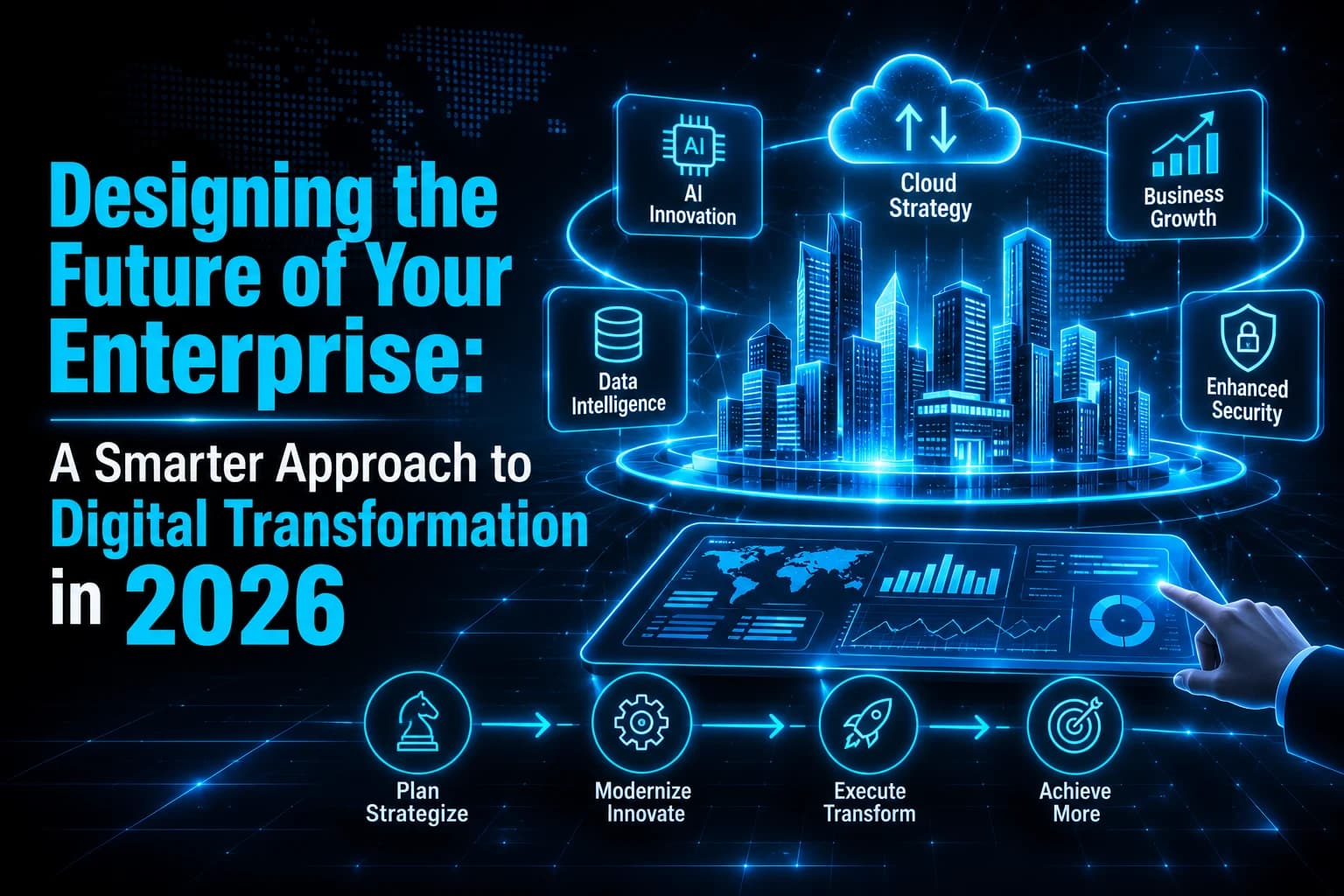
Designing the Future of Your Enterprise: A Smarter Approach to Digital Transformation in 2026
Digital transformation is no longer limited to adopting new software or moving business applications to the cloud. In 2026, organizations need to understand how their technology, people, processes, data, and business objectives work together. As enterprises adopt AI, expand cloud infrastructure, modernize legacy applications, and introduce new digital services, their technology environments become increasingly interconnected. Managing these environments without a clear understanding of their relationships can lead to duplicated investments, operational complexity, security risks, and slower decision-making. A more effective approach is to develop a connected view of the enterprise, allowing business and technology leaders to understand existing capabilities, evaluate potential changes, and make decisions based on measurable business value.
Why Enterprise Digital Transformation Needs a New Approach
Many organizations have already invested in enterprise resource planning systems, customer relationship management platforms, cloud services, analytics tools, and specialized business applications. However, having multiple technology platforms does not automatically create an efficient digital business.
The real challenge is understanding how these systems interact and how they support everyday business operations. A change in one application may affect customer services, financial processes, reporting systems, data pipelines, and other connected operations.
For example, replacing an outdated business application may appear to be a straightforward technology upgrade. But if several departments depend on its information or integrations, the change could affect multiple workflows.
Enterprise transformation therefore needs to move beyond individual technology upgrades. Businesses need a broader strategy that connects technology decisions with operational requirements, organizational priorities, and long-term growth.
Understanding the Modern Enterprise Technology Landscape
A modern enterprise operates through a combination of technologies, services, teams, and business processes. These components may be distributed across different locations, cloud environments, vendors, and departments.
A typical enterprise technology environment may include:
Core business applications: ERP, CRM, finance, supply chain, HR, and operational management systems.
Cloud infrastructure: Public cloud platforms, private cloud environments, storage, networking, and computing services.
Data platforms: Data warehouses, data lakes, analytics systems, reporting platforms, and data integration services.
SaaS applications: Subscription-based tools for collaboration, communication, productivity, marketing, and business operations.
Legacy applications: Older systems that continue supporting essential business functions.
AI and automation platforms: Machine learning services, intelligent assistants, workflow automation, and predictive analytics solutions.
Security and governance systems: Identity management, access controls, monitoring, compliance, and information protection.
These technologies should not be evaluated as isolated investments. Their value depends on how effectively they support the wider organization.
The Hidden Problems Behind Disconnected Enterprise Systems
When different departments manage technology information separately, organizations can develop an incomplete understanding of their own IT environment. Information may be distributed across spreadsheets, project management tools, infrastructure dashboards, vendor portals, and departmental documentation.
This fragmentation creates several challenges that can affect business performance.
1. Limited Visibility Across Technology Investments
Different teams may maintain separate records of applications, software licences, infrastructure costs, and ongoing projects. Without a consolidated view, leadership may struggle to identify overlapping tools or unnecessary expenditure.
For example, two departments might independently purchase applications that perform similar functions. Without visibility into existing investments, the organization may continue paying for duplicate capabilities.
2. Unclear Dependencies Between Applications
Business applications rarely operate independently. They exchange information through APIs, integrations, databases, and automated workflows.
If an organization does not understand these dependencies, replacing or modifying one system can create unexpected issues in other parts of the business.
Mapping application relationships helps teams understand which services, processes, and users may be affected before making technical changes.
3. Increasing Technology and Operational Costs
As businesses adopt more digital tools, subscription charges, infrastructure expenses, maintenance requirements, and integration costs can increase.
Some applications may remain active even when their business purpose has changed. Others may provide overlapping functionality or require expensive maintenance.
Regular technology assessments help organizations identify underused resources, simplify application portfolios, and direct budgets toward more valuable initiatives.
4. Greater Security and Compliance Exposure
Disconnected systems make it harder to understand where sensitive information is stored, who can access it, and how it moves between applications.
This can create gaps in access management, data protection, regulatory compliance, and incident response.
A connected view of applications, data ownership, security controls, and business responsibilities helps organizations identify potential exposure and coordinate corrective action.
5. Slower Business and Technology Decisions
When information is incomplete or spread across multiple teams, decision-makers spend valuable time collecting and validating details before they can evaluate an initiative.
This can delay modernization projects, cloud migrations, application replacements, and digital product launches.
A shared and regularly updated source of enterprise information helps stakeholders evaluate options more quickly and make decisions with greater confidence.
Enterprise Architecture: Connecting Business Strategy with Technology
Enterprise architecture provides a structured way to understand the relationship between business objectives, organizational capabilities, applications, information, infrastructure, and technology investments.
Rather than focusing only on technical diagrams, enterprise architecture helps explain how technology supports the activities that create business value.
For example, an online order process may depend on a customer-facing website, inventory management application, payment gateway, warehouse system, delivery platform, and financial reporting solution.
Understanding these relationships makes it easier to evaluate the impact of changes, identify modernization opportunities, and avoid introducing unnecessary complexity.
A practical enterprise architecture approach should remain connected to real business decisions. Its purpose is not simply to document the current environment but to help organizations determine how their technology landscape should evolve.
Building a Connected View of the Enterprise
One of the most valuable steps in enterprise transformation is bringing information from different business and technology sources into a common operating view.
This does not necessarily mean replacing existing systems or forcing every department to use one application. Instead, organizations can establish a structured information model that connects important enterprise elements.
These elements may include:
Business capabilities: The activities and functions that enable the organization to operate and deliver value.
Applications: The software platforms supporting business activities.
Technology infrastructure: Cloud services, networks, servers, databases, and hosting environments.
Business processes: The workflows through which work moves across departments.
Data assets: Information used by applications, teams, analytics, and AI services.
People and ownership: The individuals or departments responsible for systems, information, and decisions.
Projects and initiatives: Planned changes, investments, migrations, and modernization activities.
Risks and controls: Security concerns, compliance requirements, operational dependencies, and governance responsibilities.
Connecting these elements provides a more complete understanding of the enterprise and creates a stronger foundation for planning future changes.
Why Relationships Matter More Than Technology Inventories
A simple list of enterprise applications can explain what systems an organization owns, but it cannot fully explain how those systems influence one another.
Understanding relationships provides additional context. It helps teams identify which business processes depend on an application, which data sources it uses, which integrations support it, and which departments may be affected by a change.
A connected enterprise information model can help answer practical questions such as:
- Which business operations depend on a particular application?
- What systems could be affected if a database or cloud service becomes unavailable?
- Are multiple applications providing similar business capabilities?
- Which modernization projects depend on the same infrastructure?
- Where does sensitive information move between business systems?
- Which technology investments support the organization's highest-priority objectives?
This relationship-driven approach improves the quality of enterprise analysis and helps organizations evaluate changes beyond the boundaries of individual platforms.
From Traditional Documentation to Enterprise Decision Intelligence
Traditional enterprise architecture activities often focus on maintaining application lists, technical diagrams, standards, and transformation roadmaps. These resources remain useful, but their real value depends on how they support business decisions.
Enterprise decision intelligence takes this approach further by combining business context, technology information, operational data, and analytical capabilities.
Instead of only asking what applications exist, decision-makers can investigate the potential consequences of specific changes.
For example, before retiring a legacy system, an organization can evaluate its connected processes, data dependencies, integrations, operational importance, and replacement requirements.
Before approving a cloud migration, leaders can assess application readiness, security requirements, infrastructure costs, performance expectations, and potential operational impact.
This makes enterprise architecture more action-oriented. It helps organizations compare options, identify trade-offs, and prioritize investments according to business outcomes.
How AI Is Changing Enterprise Architecture in 2026
Artificial intelligence is creating new opportunities for organizations to analyze information, automate repetitive activities, and improve business decisions. Enterprise architecture is also evolving as AI-assisted tools become part of technology planning and governance.
AI can support enterprise teams in several ways:
1. Faster Enterprise Information Analysis
AI-assisted analysis can help review large volumes of application information, technical documentation, project records, and system relationships.
It can identify possible duplicates, highlight missing information, summarize technical environments, and help teams investigate areas that require further review.
2. Identifying Risks and Dependencies
When connected to reliable enterprise information, AI can help identify relationships between applications, infrastructure, business processes, and data assets.
These insights can support impact assessments and help teams identify areas that require additional security, compliance, or operational attention.
3. Supporting Scenario Planning
Enterprise leaders often need to compare different modernization strategies. AI-supported analysis can help organize possible scenarios, summarize expected trade-offs, and identify questions that need human evaluation.
For example, teams can compare the potential implications of maintaining an existing platform, upgrading it, replacing it, or moving selected workloads to cloud infrastructure.
4. Improving Technology Governance
AI can assist with reviewing technology standards, identifying potentially outdated components, and highlighting information that may require governance attention.
However, AI-generated recommendations should always be checked against verified data, business context, security requirements, and responsible human approval.
Why Reliable Data and Governance Are Essential for AI
AI tools can produce useful insights only when they have access to accurate, relevant, and appropriately governed information.
If application records are outdated, system ownership is unclear, or data dependencies are missing, AI-generated analysis may create misleading conclusions.
For this reason, organizations should establish clear data ownership, access permissions, validation processes, and information governance before expanding AI across enterprise operations.
Important considerations include:
Data quality: Enterprise information should be accurate, consistent, and regularly reviewed.
Access management: AI systems should only access information permitted for their intended purpose.
Data privacy: Sensitive business and customer information must be handled according to applicable privacy requirements.
Traceability: Important recommendations should be explainable and linked to the information used.
Human oversight: High-impact technology and business decisions should remain subject to appropriate human review.
Continuous monitoring: AI outputs and connected workflows should be monitored for errors, unexpected behavior, and changing risks.
Responsible AI adoption requires more than choosing a model or platform. It requires a reliable foundation of enterprise information and governance.
Creating a Practical Enterprise Digital Transformation Strategy
Digital transformation becomes more manageable when organizations divide the journey into clear activities. The following approach provides a practical framework for evaluating the current environment and planning improvements.
Step 1: Understand the Current Business and Technology Environment
Begin by identifying important business capabilities, applications, infrastructure, data assets, integrations, and operational processes.
Consult the teams responsible for these areas and validate the information against available technical and business records.
Step 2: Identify Business Challenges and Transformation Goals
Determine which problems the organization wants to solve. These may include high operating costs, slow processes, limited system integration, outdated applications, poor data visibility, or customer experience challenges.
Translate these problems into measurable objectives so that transformation initiatives can be evaluated against business outcomes.
Step 3: Evaluate Applications and Technology Investments
Review existing applications according to business importance, maintenance requirements, performance, security, cost, and technical suitability.
Identify systems that should be retained, improved, consolidated, replaced, or considered for retirement.
Step 4: Map Dependencies and Operational Risks
Document important application integrations, data flows, infrastructure relationships, business dependencies, and ownership responsibilities.
This assessment helps teams understand the wider impact of proposed changes and prepare mitigation plans before implementation.
Step 5: Prioritize Initiatives According to Business Value
Not every technology improvement needs to happen immediately. Compare initiatives according to their expected business benefits, implementation effort, cost, risk, and strategic importance.
Prioritize changes that address critical operational problems or create a strong foundation for future transformation.
Step 6: Develop a Realistic Modernization Roadmap
Organize approved initiatives into manageable phases with clear owners, milestones, dependencies, budgets, and success measures.
A phased roadmap allows the organization to deliver improvements progressively while maintaining visibility into the overall transformation strategy.
Step 7: Monitor Outcomes and Continuously Improve
After implementation, evaluate whether the initiative achieved its intended results. Review operational performance, user adoption, costs, security, and business impact.
Use these findings to improve future decisions and update the enterprise transformation roadmap as business needs evolve.
Enterprise Digital Transformation Planning Framework
| Planning area | Key activity | Expected outcome |
|---|---|---|
| Business understanding | Identify capabilities, processes, and objectives | Clear business priorities |
| Technology assessment | Review applications, infrastructure, and data | Visibility into existing investments |
| Dependency analysis | Map integrations and system relationships | Better impact assessment |
| Risk management | Evaluate operational, security, and compliance risks | Reduced transformation uncertainty |
| Investment prioritization | Compare value, effort, cost, and risk | More informed funding decisions |
| Roadmap development | Define phases, owners, and milestones | Coordinated implementation |
| Performance measurement | Track outcomes and review improvements | Continuous optimization |
Measuring the Success of Enterprise Transformation
A digital transformation initiative should be measured by the improvements it creates, not simply by the number of applications deployed or systems migrated.
Organizations can use several indicators to evaluate progress:
Technology cost efficiency: Tracks infrastructure spending, software licences, and application maintenance costs.
Application utilization: Helps identify unused, underused, or overlapping enterprise tools.
Process efficiency: Measures improvements in operational speed, accuracy, and workflow completion.
System availability: Evaluates the reliability of critical applications and infrastructure.
Integration effectiveness: Measures the reliability and performance of data exchange between systems.
Security and compliance performance: Tracks vulnerabilities, access-control issues, audit findings, and remediation progress.
Project delivery performance: Evaluates milestone completion, investment utilization, and implementation outcomes.
Business value realization: Measures whether transformation initiatives contribute to productivity, customer experience, revenue opportunities, or reduced operating effort.
The most useful measurement framework connects technical performance with the business objectives behind each investment.
Common Mistakes to Avoid During Enterprise Transformation
Treating digital transformation as a technology-only project: Business processes, people, and organizational responsibilities must also evolve.
Replacing systems without dependency analysis: A technology change can affect multiple applications and business operations.
Ignoring existing investments: Organizations may spend unnecessarily when they fail to assess the capabilities already available to them.
Adopting AI without information governance: Poor-quality data and unclear ownership can lead to unreliable recommendations and increased risk.
Creating roadmaps without business priorities: Transformation initiatives should support measurable organizational goals.
Overcomplicating architecture documentation: Information should be useful, accessible, and regularly maintained rather than becoming an outdated collection of diagrams.
Measuring activity instead of results: Completing a migration or launching an application does not automatically prove that the business has improved.
Avoiding these mistakes requires continuous collaboration between business leaders, technology teams, data owners, and operational stakeholders.
The Future of Enterprise Technology: What Businesses Should Prepare For
Enterprise environments will continue to evolve as organizations adopt more intelligent applications, distributed infrastructure, automated workflows, and connected data platforms.
AI-enabled operations: AI assistants and automated agents will increasingly support business workflows, analysis, and decision-making.
Cloud and hybrid infrastructure: Businesses will continue balancing scalability, performance, security, and cost across different infrastructure environments.
Stronger data governance: Data ownership, quality, lineage, and access controls will become increasingly important as analytics and AI usage expand.
Composable enterprise applications: Organizations will seek flexible systems that can connect through APIs and evolve without requiring complete platform replacements.
Continuous security and compliance: Security practices will need to become part of everyday technology operations rather than separate review activities.
Greater focus on business resilience: Enterprises will invest in reliable infrastructure, recovery planning, monitoring, and operational continuity.
Organizations that understand the relationships between these technologies and their business operations will be better positioned to adapt to future changes.
How VayuZon Technology Supports Digital Business Growth
Successful digital transformation requires a combination of business understanding, technical planning, reliable development, and continuous improvement.
VayuZon Technology works across software development and digital technology services to help businesses strengthen their digital capabilities and build solutions aligned with their operational requirements.
From web and mobile application development to cloud-related solutions, product engineering, and ongoing technical support, businesses need a development approach that considers both immediate requirements and long-term objectives.
A clear understanding of existing systems, user needs, and business priorities helps create a stronger foundation for new digital products and technology improvements.
Explore VayuZon's technology and development services at https://www.vayuzon.com/services.
Final Thoughts
The future of enterprise transformation depends on how effectively organizations connect business strategy with technology decisions. Adding more applications or adopting emerging technologies is not enough when the wider enterprise remains difficult to understand.
Businesses need visibility into their applications, data, processes, infrastructure, dependencies, and investments. This information makes it easier to evaluate change, identify risks, reduce unnecessary complexity, and prioritize initiatives that create measurable value.
As AI and automation become more deeply integrated into enterprise operations, reliable information and responsible governance will be essential for making informed decisions.
By building a connected view of the enterprise and following a clear transformation roadmap, organizations can modernize with greater confidence, improve operational resilience, and design a digital future that supports their own business goals.
A connected enterprise is better equipped to understand its current technology environment and prepare for future opportunities. With clear architecture, reliable data, responsible AI adoption, and a business-focused transformation strategy, organizations can make technology work more effectively for their long-term goals.
Frequently Asked Questions
What is enterprise digital transformation?
Enterprise digital transformation is the process of improving business operations, services, and decision-making through technology, data, automation, cloud platforms, and modern software solutions.
What is enterprise architecture?
Enterprise architecture is a structured approach to understanding how business processes, applications, data, infrastructure, and technology investments work together to support organizational goals.
Why is enterprise architecture important for digital transformation?
It helps organizations understand existing technology environments, identify dependencies, evaluate risks, prioritize investments, and align modernization initiatives with business objectives.
How can businesses manage disconnected enterprise systems?
Businesses can improve visibility by documenting applications, integrations, data flows, ownership, and business dependencies. Connecting this information through a shared enterprise model helps teams make better decisions.
What is enterprise decision intelligence?
Enterprise decision intelligence combines business context, technology information, data, and analytical capabilities to help leaders evaluate options and make informed decisions about transformation and investment.
How is AI changing enterprise architecture in 2026?
AI can assist with enterprise information analysis, dependency identification, scenario planning, risk assessment, and governance activities. Its recommendations should be validated using accurate data and appropriate human oversight.
What is a Digital Twin of an Organization?
A Digital Twin of an Organization is a digital representation of important business elements and their relationships. It can help organizations understand how processes, applications, resources, and planned changes interact.
How can enterprises reduce technology costs?
Organizations can assess application utilization, identify duplicate tools, review software licences, optimize cloud resources, and prioritize modernization investments according to business value.
What are the main challenges of enterprise digital transformation?
Common challenges include disconnected systems, legacy technology, unclear data ownership, security risks, integration complexity, increasing technology costs, and limited alignment between business and IT teams.
How should a business begin its digital transformation journey?
A business should begin by identifying its operational challenges, reviewing existing technology, defining measurable goals, assessing dependencies, prioritizing initiatives, and creating a phased implementation roadmap.