
 n
nBeyond Bug Fixes: How Technical Support and Mentorship Build Resilient Software Teams
Effective support services go beyond fixing technical problems. They combine structured troubleshooting, clear communication, knowledge sharing, and technical mentorship to help businesses maintain dependable applications and empower development teams. Discover how a proactive support strategy reduces recurring issues, improves collaboration, and creates a stronger foundation for long-term digital growth.
Introduction: Support Is More Than a Help Desk
When a software application encounters an unexpected error, the immediate priority is usually to restore normal operations. However, resolving the visible problem is only one part of effective technical support. Businesses also need to understand why the issue occurred, how it can be prevented, and what their teams can learn from the experience.
As applications become more interconnected, even a seemingly minor problem can affect several business functions. A payment integration failure may interrupt transactions, an authentication error may prevent employees from accessing internal systems, and a configuration issue may disrupt an otherwise stable application.
This is where structured support services become valuable. Instead of treating every technical problem as an isolated incident, organizations can establish repeatable troubleshooting processes, document solutions, and provide developers with the guidance they need to handle similar challenges more effectively.
Technical mentorship adds another important dimension. By sharing practical knowledge, reviewing problem-solving approaches, and helping team members understand unfamiliar systems, experienced engineers can strengthen the team's ability to manage future technical challenges.
Key Takeaways
Effective technical support addresses the underlying causes of application problems instead of repeatedly applying temporary fixes.
Structured ticket management and clear escalation procedures help teams prioritize issues and maintain accountability.
Technical mentorship improves knowledge sharing, debugging skills, and confidence when working with complex applications.
Centralized documentation reduces dependency on individual employees and makes troubleshooting knowledge accessible across teams.
Regular reviews of recurring incidents help organizations identify weaknesses in workflows, integrations, and application architecture.
A combination of technical expertise, communication, and continuous learning creates a more sustainable support model.
1. Why Traditional Troubleshooting Often Falls Short
Many support teams operate under constant pressure to resolve issues quickly. While speed matters, a process focused exclusively on closing tickets can overlook the reasons problems continue to return.
For example, a web application may repeatedly experience login failures because of an expired configuration value, inconsistent session handling, or an integration issue. Restarting a service might restore access temporarily, but the same failure can happen again if the underlying cause remains unresolved.
Other common challenges include incomplete error reports, missing technical documentation, unclear ownership, and communication gaps between support engineers and development teams.
A more effective approach combines immediate recovery with root-cause investigation. Every significant incident should help the team understand what happened, identify contributing factors, and determine whether a permanent corrective action is necessary.
2. Building a Structured Application Support Workflow
A reliable support process gives every technical issue a clear path from reporting to resolution. It helps teams avoid duplicated effort, prioritize business-critical problems, and communicate progress to the people affected.
A practical workflow can include the following stages:
Issue Registration: Record the reported problem, affected functionality, error messages, reproduction steps, and relevant screenshots or logs.
Prioritization and Assignment: Assess the business impact and urgency, then assign the issue to the appropriate support engineer or technical team.
Investigation and Diagnosis: Review application behavior, logs, recent deployments, configurations, dependencies, and integration responses to identify possible causes.
Resolution and Verification: Apply an appropriate fix or workaround, test the affected functionality, and confirm that related workflows continue to operate correctly.
Documentation and Closure: Record the resolution, explain any remaining risks, and provide the requester with a clear summary of the outcome.
For recurring or high-impact incidents, teams should also review the underlying cause and define preventive actions. This makes support a continuous improvement process rather than a series of disconnected fixes.
3. Technical Mentorship: Turning Experience into Team Capability
Technical mentorship helps developers and support engineers understand not only what to do, but why a particular solution works. This distinction is especially important when teams work with unfamiliar codebases, complex integrations, or legacy applications.
An experienced engineer can guide a team member through debugging techniques, code review feedback, API behavior, database queries, deployment practices, and secure coding principles. Instead of simply providing the final answer, the mentor explains the reasoning behind the solution.
Practical mentorship can take several forms:
• Guided debugging sessions that demonstrate how to investigate errors systematically.
• Code reviews that explain maintainability, readability, testing, and design considerations.
• Technical walkthroughs that help developers understand application architecture and dependencies.
• Pair programming for complex tasks that benefit from collaborative problem-solving.
• Knowledge-sharing sessions covering recurring incidents, lessons learned, and new tools.
When mentorship becomes part of everyday technical work, teams can develop stronger troubleshooting habits, share responsibility more effectively, and reduce unnecessary dependence on a small number of experienced engineers.
4. Documentation That Makes Support More Effective
Technical knowledge is difficult to reuse when it exists only in private messages, individual memory, or scattered notes. If the person who previously resolved an issue is unavailable, another engineer may need to repeat the entire investigation.
A centralized and regularly maintained knowledge base helps prevent this problem. It gives support teams a consistent reference for known errors, standard procedures, application dependencies, and verified solutions.
Useful support documentation can include:
• Troubleshooting guides for frequently reported application errors.
• Setup instructions and environment configuration requirements.
• API integration notes, dependency information, and expected response behavior.
• Deployment, rollback, backup, and recovery procedures.
• Escalation contacts, incident ownership, and communication guidelines.
• Post-incident summaries describing the root cause and preventive measures.
Documentation should be clear enough for another qualified team member to follow. Teams should also review sensitive information before sharing records and avoid storing passwords, access tokens, or other secrets in ordinary support documents.
5. Improving Communication Between Support and Development
Application issues frequently cross team boundaries. A support engineer may identify a customer-facing error, while the actual cause lies in a backend service, third-party API, database query, or recent frontend release.
Without clear communication, teams can spend time transferring incomplete information or investigating the same symptoms independently. A structured handoff helps the next team begin with useful evidence instead of starting from scratch.
A high-quality technical handoff should explain the observed behavior, expected behavior, affected users or workflows, reproduction steps, relevant logs, recent changes, and investigations already completed.
Shared ticketing systems and agreed escalation procedures make ownership easier to track. Short incident reviews can also help support and development teams agree on corrective actions and prevent similar communication gaps.
The objective is not simply to transfer responsibility. It is to create a collaborative process in which each team contributes its expertise to resolving the issue and improving the application.
6. Measuring Support Quality Beyond Ticket Closure
The number of closed tickets does not provide a complete picture of support effectiveness. A team may resolve many requests quickly while recurring defects, unclear documentation, or customer frustration continue to affect the business.
A more useful evaluation considers several indicators together:
Time to First Response: Measures how quickly a reported issue receives an initial acknowledgement or meaningful response.
Time to Resolution: Tracks how long it takes to restore the affected functionality or deliver an agreed solution, taking issue complexity into account.
Recurring Incident Rate: Highlights problems that return after previous resolutions and may require deeper investigation.
First-Contact Resolution: Shows how often issues can be resolved without unnecessary transfers or repeated follow-ups.
Support Satisfaction: Captures feedback about communication, clarity, professionalism, and the usefulness of the resolution.
Knowledge Base Utilization: Helps teams understand whether documented solutions are being used and where additional guidance may be required.
These indicators should be interpreted in context rather than used as isolated targets. For example, rushing to reduce resolution time can lead to incomplete fixes. Combining operational metrics with incident reviews provides a more balanced view of support quality.
7. Strengthening Security and Reliability Through Support
Technical support also plays an important role in maintaining application security. Reported errors can reveal outdated dependencies, unexpected access behavior, misconfigured permissions, or weaknesses in existing operational procedures.
Support teams should follow established processes for reporting suspected vulnerabilities, reviewing access permissions, applying approved updates, and escalating security-sensitive incidents to authorized personnel.
Routine operational checks can also help identify expired certificates, failing integrations, unusual application behavior, storage limitations, and configuration inconsistencies before they create wider disruption.
However, troubleshooting must follow appropriate access controls. Engineers should use approved environments, protect customer information, avoid exposing sensitive data in tickets, and verify changes before applying them to production systems.
By connecting support activities with established security and release-management practices, organizations can improve application reliability without introducing unnecessary operational risks.
8. Creating a Continuous Improvement Plan for Support Services
A mature support strategy evolves as applications, teams, and business requirements change. Organizations can establish a continuous improvement cycle that turns individual support experiences into long-term operational improvements.
Review Common Issues: Identify frequently reported problems and determine whether they share a technical or procedural cause.
Prioritize Preventive Actions: Select improvements based on business impact, security considerations, recurrence, and implementation effort.
Share Technical Knowledge: Convert useful troubleshooting discoveries into documentation, mentoring sessions, or reusable diagnostic procedures.
Validate Improvements: Test corrective changes and verify that they address the original issue without introducing new problems.
Review Outcomes: Evaluate recurring incidents, user feedback, support workload, and the effectiveness of completed actions.
This cycle helps support teams gradually reduce avoidable work while improving their ability to respond to complex issues. It also creates a practical connection between day-to-day technical support and broader engineering quality.
9. How Vayuzon Technology Can Support Your Team
Every organization has different application requirements, technical constraints, and support priorities. An effective support approach should reflect the systems a business operates, the experience of its internal team, and the level of assistance required.
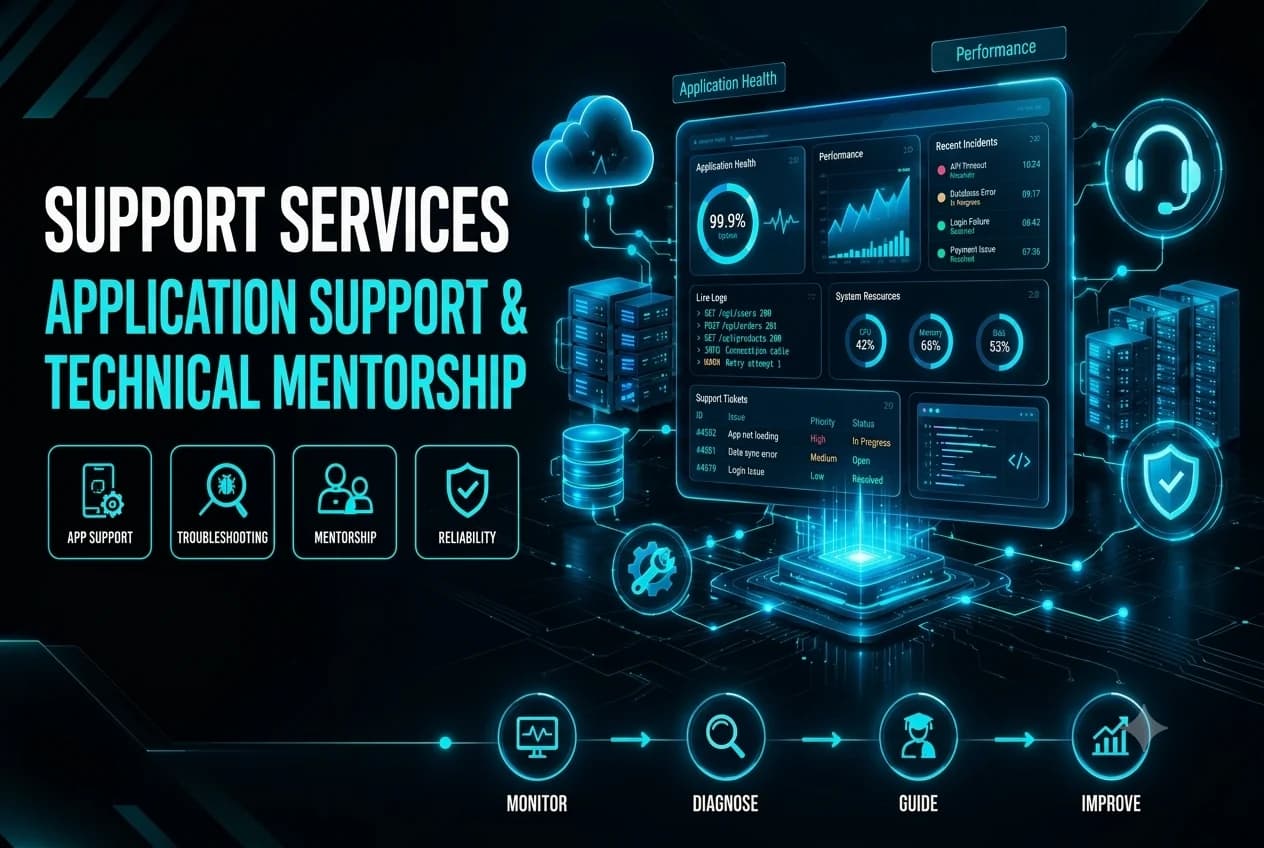
Vayuzon Technology's Support Services focus on helping businesses address technical challenges through application support, structured troubleshooting, and technical mentorship.
Application Support: Assistance with investigating application issues, understanding unexpected behavior, and coordinating appropriate corrective actions.
Technical Mentorship: Practical guidance that helps developers strengthen debugging techniques, understand implementation decisions, and work more confidently with application technologies.
Knowledge Sharing: Clear technical explanations and reusable documentation that help teams understand resolutions and apply lessons to future work.
Collaborative Problem-Solving: Support for identifying possible causes, reviewing implementation approaches, and coordinating with the relevant technical stakeholders.
The specific scope, response arrangements, and engagement model should be defined according to each client's requirements. With the right support structure, businesses can improve their technical workflows while allowing internal teams to remain focused on their core objectives.
Conclusion: Build a Stronger Support Culture
Reliable support services require more than responding to errors as they appear. They depend on a structured troubleshooting process, clear communication, reusable technical documentation, and a commitment to understanding the causes behind recurring problems.
Technical mentorship strengthens this foundation by helping teams develop practical skills, learn from experienced engineers, and share knowledge across projects. Combined with consistent incident reviews and appropriate security practices, it creates a more sustainable approach to application support.
For growing businesses, the goal should be to build a support process that resolves today's issues while improving the team's ability to handle tomorrow's challenges. By combining application support with technical mentorship and continuous improvement, organizations can create more dependable digital operations and a stronger foundation for future development.
Looking to strengthen your application's support process or provide your development team with additional technical guidance? Connect with Vayuzon Technology to discuss a support approach aligned with your business and technical requirements.