
 n
nAI in Healthcare Products: The Product Engineering Reality Behind the Hype
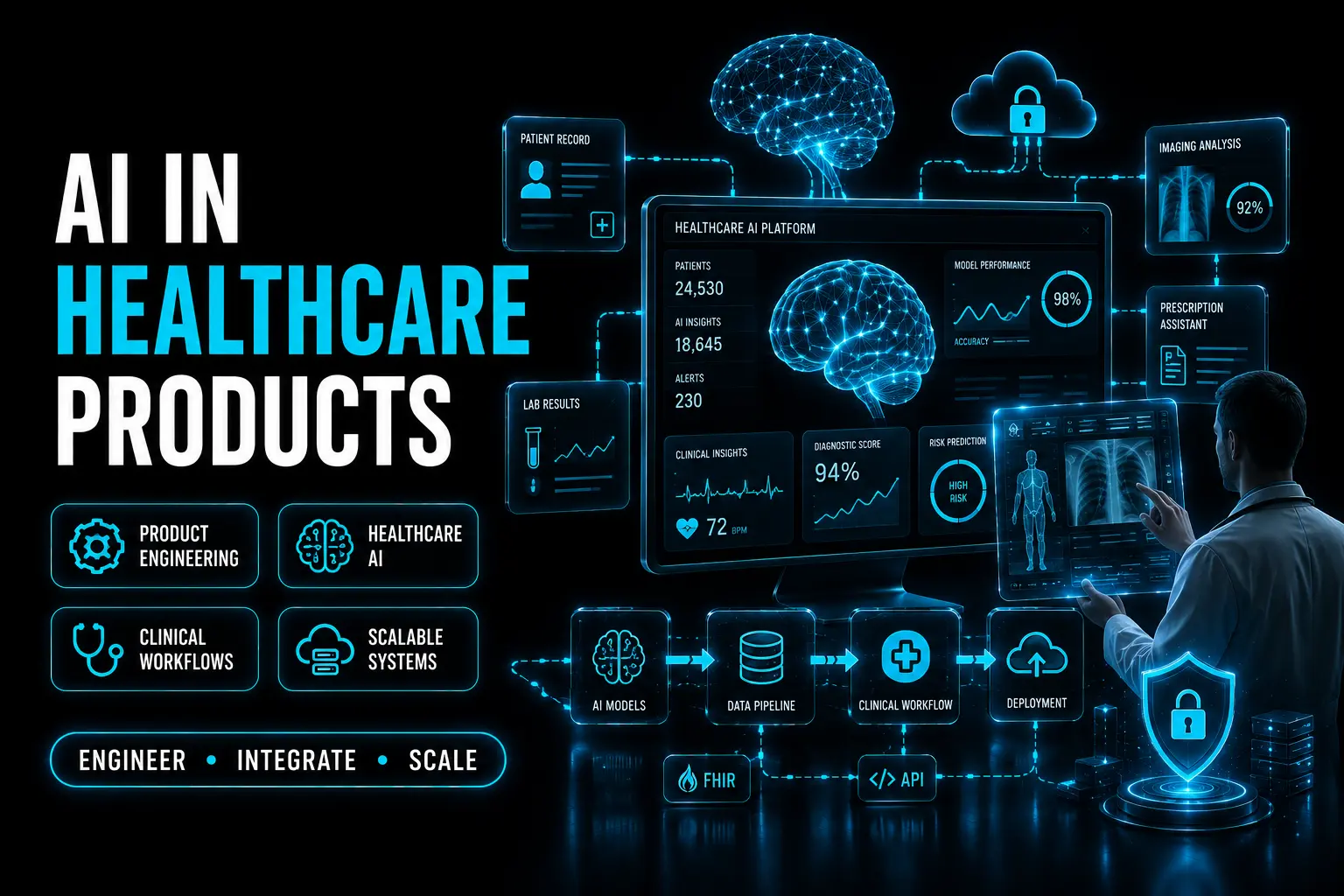
Artificial Intelligence is transforming healthcare, but successful AI solutions require far more than accurate machine learning models. Learn how product engineering, clinical workflow integration, scalable architecture, and continuous monitoring determine whether healthcare AI succeeds or fails in real-world environments.
Introduction
Artificial Intelligence has become one of the most talked-about technologies in healthcare. From predictive diagnostics to autonomous clinical support systems, AI is often presented as the next breakthrough capable of transforming patient care and clinical operations. However, while many AI models perform exceptionally well during laboratory testing, they often struggle when deployed in real healthcare environments.
The challenge is rarely the algorithm itself. Many healthcare AI initiatives fail because of fragmented data architecture, poor workflow integration, rushed implementation, and legacy systems that were never designed to support AI. A highly accurate model can quickly become ineffective if clinicians cannot trust or efficiently use it within their daily workflows.
The real question for healthcare leaders is no longer 'How accurate is the AI model?' Instead, organizations should ask whether they are building an AI algorithm or engineering a complete healthcare product that happens to use AI. This distinction determines whether AI becomes a strategic advantage or an expensive experiment that creates technical debt.
This guide explores how product engineering principles help healthcare organizations build AI-powered platforms that deliver measurable clinical value while remaining secure, scalable, and reliable.
TL;DR
Key takeaways for healthcare technology leaders: • Successful healthcare AI projects are product engineering initiatives rather than standalone machine learning projects. • The strongest real-world AI use cases include diagnostic imaging, predictive risk modeling, and operational workflow automation. • Many AI failures occur because of biased datasets, poor clinical workflow integration, weak architecture, and lack of explainability. • Reliable healthcare AI products require strong product strategy, scalable data pipelines, explainable AI, continuous monitoring, and cloud infrastructure. • The most successful healthcare platforms allow AI to perform pattern recognition while clinicians retain responsibility for medical decisions and patient care.
1. Where AI Actually Delivers Clinical Value
Despite the widespread excitement surrounding artificial intelligence, measurable success consistently appears in only a few healthcare domains. Successful AI implementations typically share common characteristics, including structured clinical data, measurable outcomes, integration with existing healthcare workflows, and AI serving as an assistant rather than replacing clinicians.
Three healthcare applications have demonstrated the strongest results: • Diagnostic imaging • Predictive risk modeling • Operational workflow automation These areas continue to generate measurable improvements in efficiency, accuracy, and patient outcomes because they combine AI capabilities with carefully engineered healthcare products.
2. Diagnostic Imaging: AI's Most Mature Clinical Application
Medical imaging remains one of the most mature and successful applications of artificial intelligence in healthcare. Radiology and pathology involve analyzing thousands of medical images where AI excels at recognizing subtle patterns faster than human specialists while maintaining consistent performance.
Healthcare organizations have already demonstrated measurable success through AI-powered imaging systems. FDA-approved diabetic retinopathy screening tools and automated radiotherapy planning platforms significantly improve diagnosis speed while expanding access to care in regions with limited medical specialists.
However, success depends on far more than model accuracy. Healthcare organizations must engineer complete products that answer critical operational questions: • How should AI communicate confidence levels? • What happens when AI disagrees with a clinician? • How is accountability maintained? These challenges are product engineering problems rather than machine learning problems. Workflow design, interoperability, user experience, and system integration ultimately determine whether clinicians trust and adopt AI imaging solutions.
3. Predictive Risk Modeling: Moving Toward Proactive Healthcare
Predictive analytics enables healthcare providers to identify high-risk patients before serious complications occur. By analyzing electronic health records, laboratory results, patient history, and vital signs, AI models can identify patients who may require earlier intervention.
When implemented successfully, predictive risk models help reduce mortality, improve chronic disease management, lower treatment costs, and assist healthcare providers in prioritizing limited clinical resources.
However, predictive models also highlight the reality that successful AI depends on strong engineering. Widely deployed healthcare prediction systems have struggled because hospitals use different EHR configurations, clinical workflows, and data structures. These variations often reduce model performance despite excellent laboratory validation.
Effective predictive AI therefore requires scalable data architecture, standardized clinical workflows, and robust product design that adapts to real-world healthcare environments.
4. Operational AI: The Hidden Driver of Healthcare ROI
While clinical AI applications receive the most attention, many healthcare organizations achieve their greatest return on investment through operational AI. These systems improve administrative efficiency, automate repetitive work, and reduce operational costs without replacing clinical decision-making.
Common operational AI applications include: • Clinical documentation using natural language processing • Predictive patient scheduling • Insurance claims fraud detection • AI-powered patient support chatbots • Remote patient monitoring These solutions automate high-volume administrative processes while allowing healthcare professionals to focus on patient care. Their long-term success depends on cloud infrastructure, DevOps engineering, scalable architecture, and seamless integration with existing hospital systems rather than AI alone.
5. The $4 Billion Lesson: Where AI Failed
One of the most well-known examples of healthcare AI failure is IBM Watson Health. Watson for Oncology promised to revolutionize cancer treatment by analyzing patient records and medical research to recommend treatment plans. Despite billions of dollars invested, the platform struggled to deliver reliable recommendations in real clinical environments.
Clinical evaluations found that Watson's recommendations often failed to match oncologists' treatment decisions. The primary reason was not poor artificial intelligence but inadequate product engineering. The system had been trained largely on synthetic case studies instead of diverse real-world patient data, causing a significant gap between laboratory performance and clinical reality.
This example demonstrates an important lesson for healthcare organizations. AI models cannot succeed without robust product strategy, real-world validation, scalable architecture, and continuous improvement throughout deployment.
6. Algorithmic Bias: A Critical Risk in Healthcare AI
Bias remains one of the most significant risks when deploying artificial intelligence in healthcare. AI models are only as reliable as the data used to train them. If datasets fail to represent diverse patient populations, predictions may unintentionally disadvantage certain groups.
A widely discussed example involved Optum's healthcare risk algorithm, which managed care decisions for millions of patients. Because the model used healthcare spending as a measure of patient need, it underestimated the healthcare requirements of many Black patients whose historical healthcare spending was lower despite similar or greater medical needs.
This issue was not simply an algorithm error. It exposed weaknesses in data engineering, validation processes, and product design. Modern healthcare AI platforms must include continuous bias monitoring, diverse datasets, transparent evaluation methods, and responsible governance throughout the product lifecycle.
7. Explainability and the Challenge of Black-Box AI
Healthcare professionals must understand why an AI system generates a recommendation before they can trust it. Unlike many other industries, clinical decisions require transparency, accountability, and evidence that can be explained to patients, regulators, and healthcare organizations.
Explainable AI techniques such as SHAP (SHapley Additive exPlanations) and LIME (Local Interpretable Model-Agnostic Explanations) help identify which factors influenced a model's prediction. While these tools improve transparency, they do not automatically guarantee clinical accuracy or better patient outcomes.
Black-box AI models often face resistance because clinicians remain responsible for every medical decision they make. Product engineering teams must therefore design interfaces that clearly communicate confidence levels, supporting evidence, uncertainty, and recommended actions instead of presenting predictions without context.
8. Engineering Reliable Healthcare AI Products
Organizations that successfully deploy healthcare AI begin with clinical problems rather than algorithms. Instead of asking how to build a more accurate model, they focus on how AI can improve existing healthcare workflows while supporting clinicians instead of replacing them.
Successful healthcare AI products typically address questions such as: • What clinical decision does the AI improve? • What happens if the prediction is incorrect? • How will clinicians interact with the system? • How does the AI integrate with existing EHR platforms? • How will performance be monitored after deployment? By answering these questions early, organizations build AI solutions that are scalable, trustworthy, and capable of delivering measurable clinical value instead of becoming isolated machine learning projects.
9. Development Roadmap for Product-First Healthcare AI
A successful healthcare AI product follows a structured engineering roadmap: Problem Validation Work closely with clinicians to understand real operational challenges before developing AI models. Data Architecture Build secure, scalable, and privacy-focused data pipelines using approaches such as federated learning and standardized healthcare data models. Production-Ready Prototyping Design AI systems that integrate with hospital infrastructure, electronic health records, FHIR APIs, and existing clinical workflows. Real-World Validation Evaluate models across multiple healthcare organizations, patient populations, and time periods instead of relying solely on laboratory accuracy. Continuous Monitoring Monitor model drift, system performance, clinical outcomes, and infrastructure health while retraining models as healthcare environments evolve. Following this product engineering approach helps healthcare organizations transform AI prototypes into secure, scalable, and clinically trusted healthcare platforms.
Conclusion
Artificial Intelligence is already transforming healthcare, but long-term success depends on much more than building accurate machine learning models. Organizations must approach AI as a product engineering initiative that combines scalable architecture, secure data pipelines, seamless clinical workflow integration, explainable AI, and continuous monitoring. When supported by strong engineering practices, AI can improve diagnostic accuracy, streamline operations, and enhance patient outcomes while keeping clinicians at the center of decision-making. Healthcare providers that invest in reliable product engineering foundations will be better positioned to build trustworthy, future-ready AI solutions that deliver measurable value for both patients and healthcare professionals.