
 n
nNew trends in using free AI models locally for daily small tasks
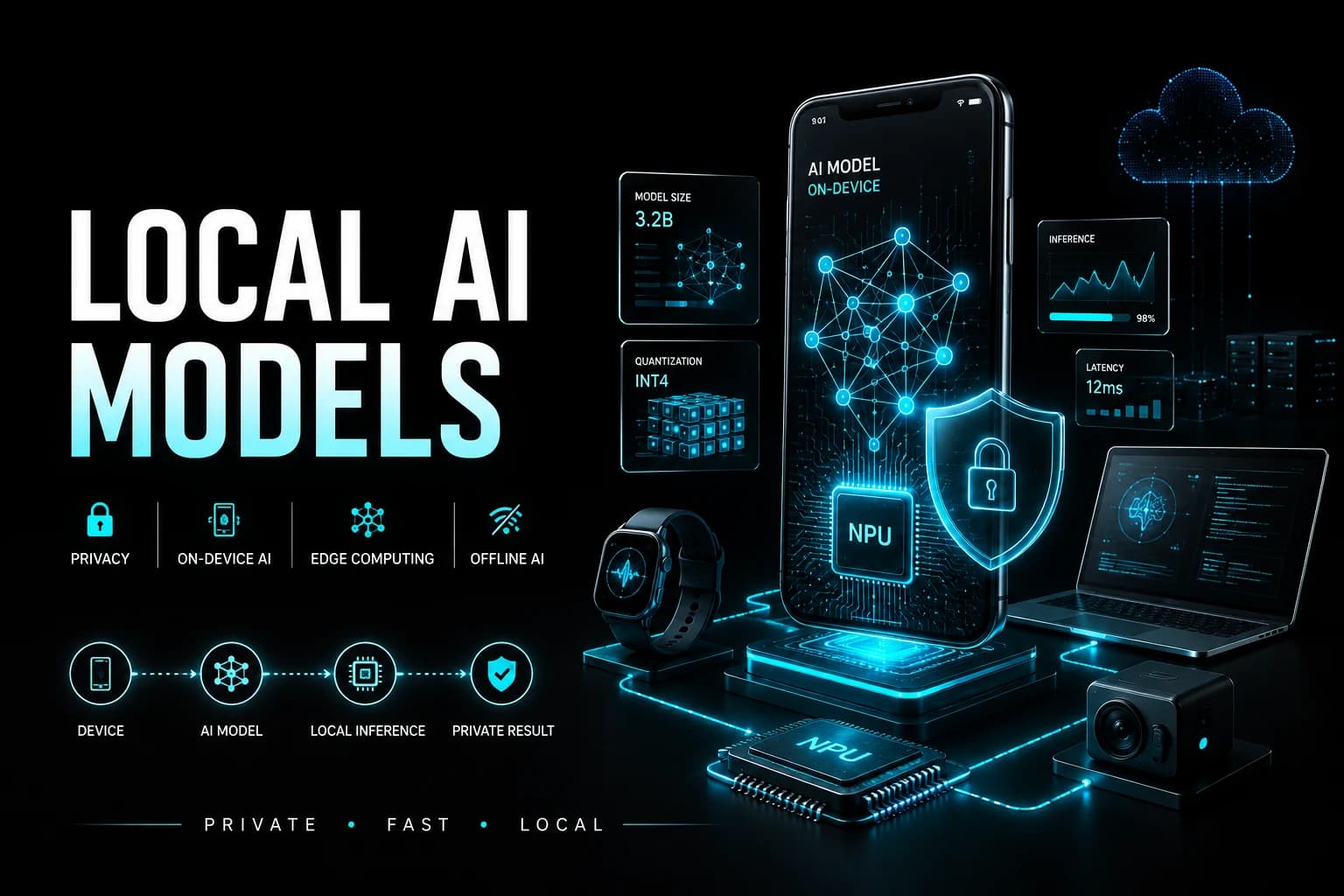
Local AI models are transforming artificial intelligence by bringing processing directly to devices. They offer improved privacy, lower latency, offline capabilities, better efficiency, and new business opportunities while introducing challenges around compute, storage, updates, security, and hardware dependence.
1. Why the Shift Toward Local AI Models
As our appetite for personalization and automation grows, so does the need for AI that is responsive and private. Cloud AI has powered the last decade of machine learning success, from smart assistants to recommendation systems. Yet it comes with challenges—constant data transfers, energy consumption, and potential privacy risks.
Privacy Comes First: Local processing means your personal data stays stored on your device. No need to send private voice commands, images, or messages to the cloud. Users gain control and confidence—especially in sectors like health or finance.
Speed and Latency: Immediate local computation means faster responses. Games, AR apps, or voice assistants perform with almost zero lag. Real-time applications, from translations to diagnostics, benefit enormously.
Efficiency and Connectivity: Local AI doesn't depend on continuous internet access. Lower energy costs for cloud providers and smaller carbon footprints overall. Efficient even in rural or low-signal areas, leveling the global tech field.
Midway through the modern AI boom, local AI models stand out as the pragmatic, sustainable evolution of artificial intelligence—proof that small can indeed be mighty.
2. Popular Small Models for Daily Tasks
Highly optimized, hyper-specific small language models under 15 billion parameters now rival much larger networks on standard consumer devices.
Qwen2.5 / Qwen3 (Alibaba):Highly versatile model families running in compact parameter options (such as 3B, 7B, or 14B) that exhibit exceptional speed and reasoning for general Q&A, drafting, and multilingual text translation tasks.
Llama 3 / 3.1 (Meta): The 8B version serves as the industry baseline for highly reliable instruction-following, standard text editing, and complex code generation.
DeepSeek-V4-Flash: is a preview of the DeepSeek-V4 series, a Mixture-of-Experts model with 284B total parameters and 13B activated, built for efficient reasoning across a 1M-token context window.
Phi-3 / Phi-4 (Microsoft): Exceptionally compact architectures designed via highly curated training datasets, making them powerhouse reasoning tools for logical sorting and math-heavy data processing.
Gemma 2 (Google): Built with advanced distillation architectures to squeeze top-tier text performance into a highly responsive, resource-efficient package optimized for laptops.
3. How Local AI Models Work & The Advantages of Local AI Models in Real Life
Local AI models run a scaled-down version of what huge cloud models do. Instead of massive clusters, they rely on efficient architectures, optimized memory use, and hardware-level accelerators, like NPUs (Neural Processing Units).
Model Compression: Techniques like quantization, pruning, and distillation reduce size without harming accuracy.
Hardware Optimization: Processors in devices are now built for AI—chips like Apple’s Neural Engine or Qualcomm’s Hexagon DSPs boost performance.
Local Inference Engine: Instead of sending data outward, the device interprets it directly—running tasks like image recognition, voice analysis, or real-time translation offline.
Edge Learning: Some local devices can even adapt or retrain on small datasets, personalizing experiences further.
Technical Example: Imagine a camera that recognizes pets for a photo app. With local AI models, the recognition runs instantly, without contacting a server. Photos never leave your phone, but accuracy remains high thanks to clever optimization.
Healthcare: Offline diagnostics tools for rural regions. Privacy-focused wearable monitoring that doesn’t upload sensitive health information.
Education: Smart tutoring apps functioning offline for students without stable internet. On-device translation for cross-language communication.
Retail: Lightning-fast checkout and recommendation systems at the point of sale. Better personalization directly inside mobile shopping apps.
Entertainment: Gaming consoles and augmented reality experiences process complex data locally. Music personalization engines adapt instantly based on your offline habits.
Each of these innovations depends on the same core philosophy: local AI models are designed to work for everyone, anywhere—no signal, no problem.
4. Challenges and Limitations
No revolution is without its rough edges. As promising as they are, local AI models face unique obstacles:
Conclusion Small models can’t yet match the raw reasoning power of their cloud-based giants. Every compression trade-off impacts nuance, creativity, or reliability in some tasks.
Update Complexity: Keeping thousands of devices updated with the latest model improvements is a logistical challenge.
Security Risks: Although local data means higher privacy, physical device access can pose new types of security threats.
Hardware Dependence: To function optimally, local AI relies heavily on specialized chips—creating disparities across devices and manufacturers.
These challenges, while significant, are driving intense innovation. As devices become smarter, more efficient, and embedded with AI-ready processors, most limitations will gradually disappear.
5. The Business Opportunity Behind Local AI Models
Companies that understand the long-term business potential of local AI models are already shaping future markets. Beyond technological efficiency, they represent a new form of trust-building between brands and consumers. When your data never leaves your device, the relationship shifts—customers start associating local AI with transparency, safety, and reliability.
Lower Costs: Cloud processing fees drop dramatically. Companies save on server infrastructure while improving app performance.
Regulatory Compliance: Data protection laws like GDPR and CCPA reward local data processing. Using local AI models helps companies stay compliant by design.
User Retention and Loyalty: Offline capability and security enhance user satisfaction. Apps feel faster and more reliable, increasing engagement.
6. Cost
The financial dynamics of local AI heavily favor long-term productivity over continuous recurring costs:
Software Costs ($0): The actual model architectures (such as Llama, Qwen, or Phi) and runner applications are entirely free and open-weight under permissive licenses.
Upfront Hardware Costs: Running these models smoothly requires a one-time hardware investment—ideally a computer equipped with unified memory (e.g., Apple Silicon M-series chips) or a dedicated NVIDIA graphics card. Basic requirements:- NVIDIA GeForce RTX 4080 (and newer RTX 4080 SUPER), at least 8GB to 16GB of VRAM, Storage 1TB SSD.
Electricity Costs (Negligible): Electricity costs for running local AI models are relatively low. Depending on the hardware and usage, local AI inference can cost approximately $0.02 per hour of use, making it a practical option for regular workloads without significant ongoing electricity expenses.
Conclusion
In the near future, we’ll see entire industries built around “edge-native” software. AI startups focused on lightweight frameworks will become critical infrastructure providers. Even global corporations will use local AI models strategically—to reduce latency, improve sustainability, and tailor digital experiences down to a single user.
IDC and Gartner predict that by 2027, over 60% of all AI inference processes will happen locally rather than in the cloud. That’s a stunning reversal of today’s paradigm and evidence that this shift isn’t temporary but fundamental.