
 n
nCustom Software vs SaaS vs Mobile Apps: Which Solution Is Right for Your Business?
Businesses choosing between custom software, SaaS, and mobile apps should evaluate factors like cost, customization, scalability, and deployment speed to find the best fit for their goals. While SaaS offers quick, affordable implementation, custom solutions provide greater flexibility, ownership, and long-term value, with many businesses benefiting from a hybrid approach.
Introduction
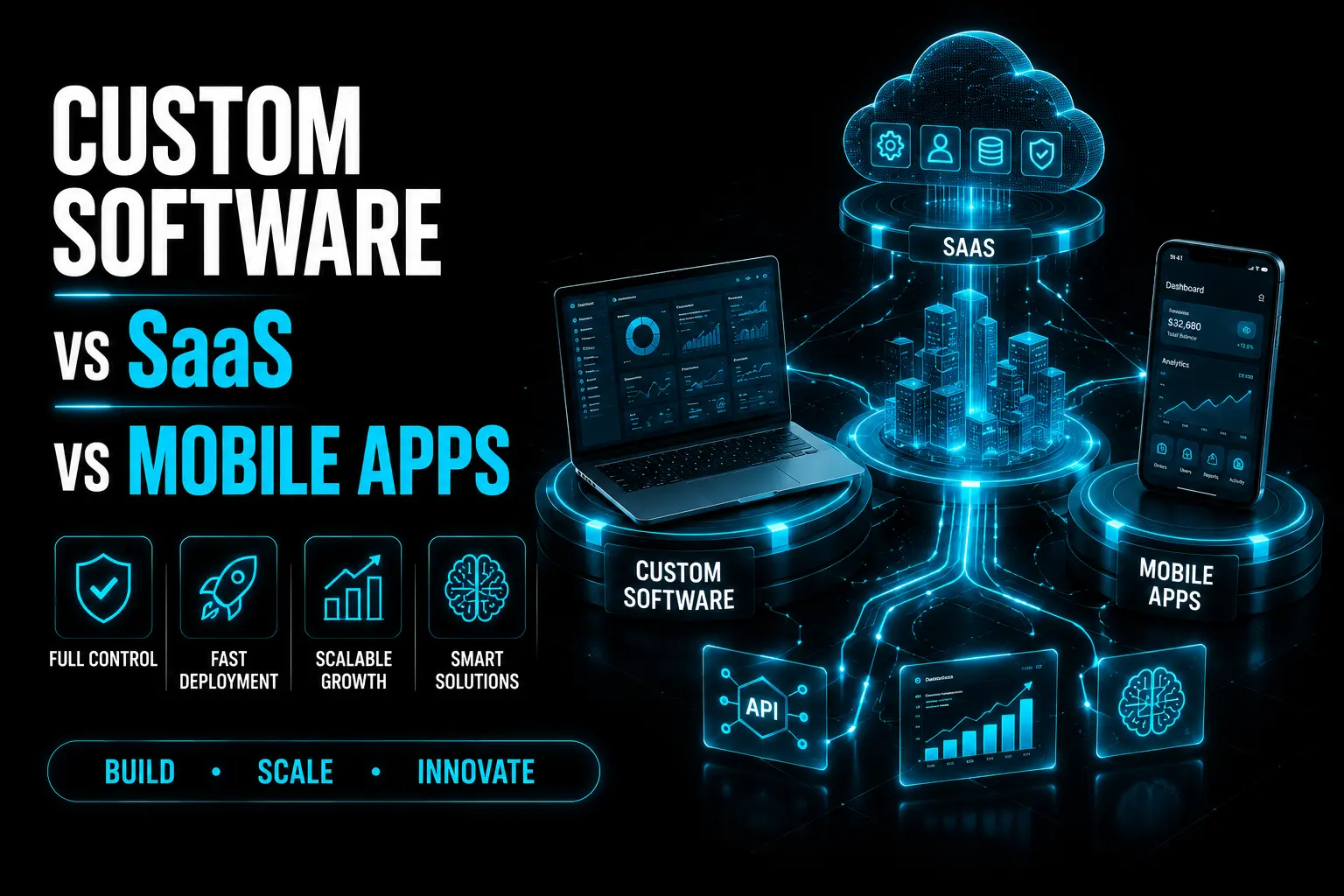
Businesses exploring scalable technology solutions must evaluate three primary options: SaaS (Software as a Service), which is ready-made software accessed via subscription, and custom software, which is built specifically for your business needs. Mobile apps represent a specialized category that can be either custom-built or SaaS-based, designed to deliver experiences on smartphones and tablets. The right choice depends on your budget, timeline, customization needs, and long-term business goals.
1. Cost Structure: Investment vs Subscription
The most significant difference lies in cost structure and financial commitment.
| Factor | SaaS | Custom Software |
|---|---|---|
| Upfront Cost | Lower initial investment | Higher initial investment |
| Payment Model | Recurring monthly/yearly subscription | One-time development + maintenance |
| Long-Term Cost | Escalating per-user license fees | More cost-effective over time |
| Ownership | No ownership (provider controls) | Full ownership and control |
SaaS is cheaper initially, making it ideal for businesses with limited budgets, but custom software can be more cost-effective in the long term by avoiding escalating license fees.
2. Flexibility, Customization, and Scalability
Customization capabilities dramatically differ between solutions:
| Factor | SaaS | Custom Software |
|---|---|---|
| Flexibility | Limited | High |
| Customization | Restricted | Full control |
| Features | Predefined, generic | Fully tailored to workflows |
| Scalability | Depends on provider | Scales as business grows |
SaaS platforms are designed for a broad audience with limited customization and predefined features. Custom software is fully tailored to business workflows and scales as your company grows, providing maximum control over data, features, integrations, and security.
3. Deployment Speed, Implementation, and Use Cases
Time-to-market varies significantly between options:
| Factor | SaaS | Custom Software |
|---|---|---|
| Setup Time | Fast (immediate after signup) | Slower (months for development) |
| Implementation | Quick deployment | Requires planning and development |
| Maintenance | Provider handles updates | You manage maintenance |
Mobile apps sit between these options—custom mobile apps offer full control and mobile-specific features, while SaaS mobile apps provide faster deployment with limited customization.
4. When to Choose Technical Mentorship
Choose SaaS When: • You need quick deployment and fast setup. • Budget is limited initially. • Standard features meet your requirements. • You're a startup needing quick launch with minimal investment.
Choose Custom Software When: • You need unique features not available in SaaS. • Business processes are complex and require tailored workflows. • Long-term scalability is critical. • You're an enterprise requiring scalability and control. • Modern custom platforms increasingly bake in generative AI capabilities from day one for personalization, automation, and decision support—capabilities most off-the-shelf SaaS tools cannot match without heavy add-ons.
Choose Custom Mobile Apps When: • You need mobile-specific functionality (GPS, camera, push notifications). • Brand differentiation through a unique mobile experience is critical. • You want full ownership of the mobile application.
Choose SaaS Mobile Apps When: • You need faster deployment for mobile presence. • You have straightforward requirements or a limited budget. • You're testing the mobile market before investing in custom development.
Conclusion
The decision between custom software, SaaS, and mobile apps depends on your specific business requirements, budget, and strategic goals. SaaS offers quick setup and lower upfront costs, making it a strong choice for startups and businesses with straightforward needs. Custom software provides tailored solutions, full control, and better long-term scalability for growing businesses and enterprises. A hybrid approach (SaaS + custom modules) often works best for growing businesses, combining the speed of SaaS with the flexibility of custom development. Ask yourself: Do you need customization? Is scalability a priority? What is your long-term vision? If most answers favor flexibility, go custom. If speed and cost matter most, go SaaS. Modern businesses frequently use both approaches depending on their needs, leveraging SaaS for common functions while building custom solutions for unique business processes.