
 n
nTop Mobile App Development Trends in 2026
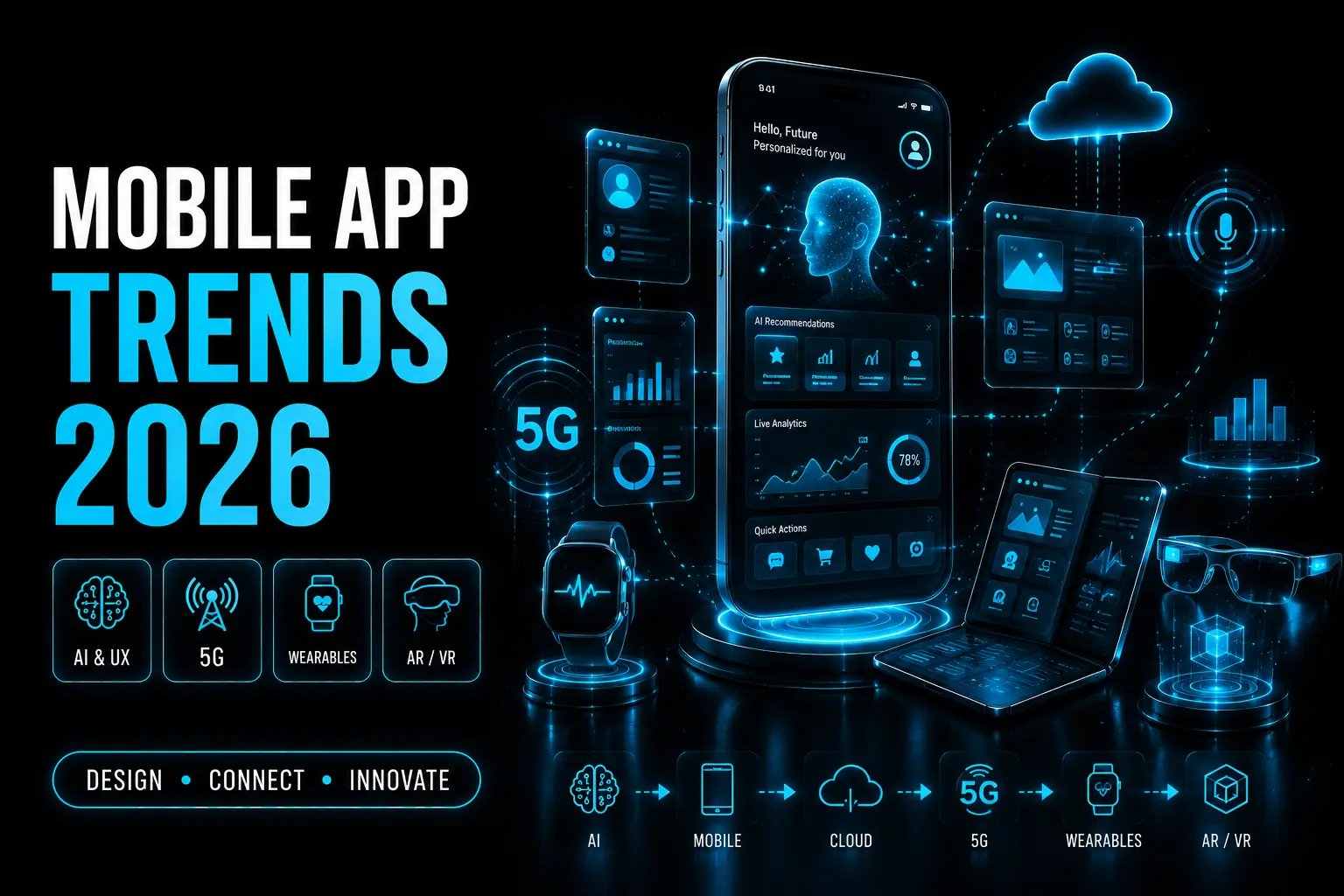
Mobile app development in 2026 is being shaped by AI-powered personalization, motion design, touchless interfaces, 5G, foldable and wearable devices, low-code platforms, predictive analytics, cloud-first applications, and emerging AR/VR experiences. Businesses are increasingly focused on creating fast, personalized, scalable, secure, and cross-device mobile experiences that align with changing user expectations.
Introduction
Building a solid digital presence isn't just about having an app anymore. It's about having the right one, a piece of software that actually fits your audience and your goals. The way a business grows today often starts with how well its app connects with people, simplifies operations, and keeps things moving in a fast-paced market.
The mobile app world itself is booming. Grand View Research reports that it was worth around $228.9 billion in 2023 and could reach $567.2 billion by 2030. That's not just growth on paper; it shows how deeply mobile experiences now shape the way businesses run and how people interact with brands every day.
Users, too, have raised the bar. They don't just want an app that works. They want something that feels personal, quick, and smooth, using AI, AR/VR, 5G, and cloud technology to make every tap feel effortless.
If you're planning to grow your digital footprint, this is the right time to dive in. This guide walks through the biggest mobile app development trends for 2026 and what they mean for businesses looking to stay ahead.
Key Takeaways
User experience takes center stage: Motion design, AI-driven personalization, and touchless interfaces are reshaping how users connect with apps.
AI and 5G fuel next-gen innovation: Smarter algorithms and lightning-fast networks are driving real-time, data-powered mobile experiences.
Design beyond the screen: Foldables, wearables, and AR devices are pushing developers to create fluid, cross-device app ecosystems.
On-demand and cloud-first apps dominate: With PwC and IDC projecting rapid market expansion, scalability and accessibility are becoming essential.
Sustainability and security define the future: Green app practices, privacy-by-design, and PWAs are setting the benchmark for responsible digital growth.
1. Double Down on Motion Design
Your app users might get impatient with complex, static designs that offer no engagement. To resolve this, one solution is Motion Design. The idea is to grab down your user's attention. Motion design icons enhance interactivity, engagement, animated scrolling, and macro interaction.
For instance, the digital product design company Appinventiv incorporated refined motion design features into Domino's app, leading to a 23% increase in conversion rate.
Motion design features in apps also save users time and deliver a remarkable experience.
2. Artificial Intelligence in Mobile App UX
It would be rather strange to discuss the latest mobile UI design trends without mentioning Artificial Intelligence. AI introduces the concept of computational design, meaning your app interfaces can be generated by automated programs rather than by designers crafting them.
AI and ML speed up the design process, with the likelihood of major changes minimal. AI design programs are set with clear parameters for mimicking the human decision-making process, so the results may not vary much.
Beyond the basics, AI is also slowly advancing in UX design iterations. For example, AI can quickly design numerous versions of a single landing page.
3. Accessibility and Inclusivity
You cannot make your users feel that your app is built for them if they don't see themselves in the design. For instance, the makers of the survival game Rust made headlines for their decision to randomize every player's skin color.
This UX design decision represented every demographic and, therefore, was a hit. Hence, one of the hottest mobile UX app design trends, alongside emerging artificial intelligence trends in mobile app experiences, accessibility, and inclusivity, is keeping users at the center of app design.
4. Touchless UI
According to the source material, 43% of UK consumers are open to using touchless technologies in their daily lives. This transition is evident as customers continue to prioritize touchless interfaces, such as facial recognition and touchless apps, reflecting a shift in consumer behavior and preferences.
Many users are already familiar with touchless UI, such as signing in to or identifying users in the app using biometrics. As a second authentication factor, finance or payment apps ask users to verify their identity with biometrics.
Another recent mobile app UI trend is gesture control, which lets users control apps by simply moving their head or the screen. Up-and-coming mobile apps can also track eye movements to help with scrolling. These innovations are shaping current trends in mobile app development and creating more intuitive, hands-free experiences.
5. Camera-Focused Mobile Apps
Businesses choosing video conference app development have seen skyrocketing revenue, especially since the rise of remote work. Users continue to engage with apps that let them broadcast videos, connect with friends, and build social networks.
TikTok is one example of a highly popular streaming and camera-focused app. The source material states that TikTok counted approximately 1.7 billion users worldwide.
Camera-based mobile application development trends are also moving into streaming entertainment, broadcasting, and social media niches.
6. Low-Code and No-Code
Low-code and no-code platforms let non-technical employees build their own tools. Customer service representatives, warehouse managers, and analysts can create solutions in hours instead of waiting months for IT.
The upside is clear. People closest to problems can fix them directly. Operations managers can build inventory systems, HR teams can automate paperwork, and marketing teams can connect tools without developers.
The downside gets overlooked. Uncontrolled building can create shadow IT nobody tracks, data trapped in silos, security gaps, and integration problems across fragmented department technology stacks.
Smart companies set boundaries through clear data access rules, mandatory security reviews, and integration standards. This enables teams to build without breaking operations.
7. New Audio-Focused Social Media Platforms
Video- and camera-based social media mobile application development trends may be the next big thing; however, traditional audio-based formats are also getting attention in the social space.
Clubhouse offers a spontaneous experience, allowing users to switch into chat rooms and join conversations. The source material states that this voice-based app has seen 100% growth in the past four years, making audio a meta-trend that extends beyond social media apps.
As audio continues to gain traction, further innovation and expansion can be expected, with new platforms and features emerging to cater to evolving user preferences.
8. Apps for Foldable and Wearable Devices
Samsung's Galaxy Fold launch in 2019 signaled a shift in mobile hardware. What started with foldable screens has expanded into an ecosystem that includes smartwatches, AR glasses, and fitness trackers.
As these devices become more mainstream, mastering wearable application development will be essential for creating seamless cross-device experiences.
According to Grand View Research, the global wearable technology market is projected to grow at a CAGR of 13.6% from 2025 to 2030. For businesses, this creates a challenge: serving users across devices with different screen sizes and interaction models.
A professional may review a complex spreadsheet on a foldable's expanded display, receive quick message alerts on a smartwatch, and later use AR glasses for turn-by-turn directions. Each scenario demands a different interface approach while users still expect consistency.
The companies winning in this space are designing experiences from the ground up to work naturally across form factors, including split-screen layouts, notifications optimized for small displays, and voice commands.
Getting this right helps businesses stay relevant as hardware continues to fragment. Missing these opportunities can make products less visible across an increasingly diverse device landscape.
9. Predictive Analytics
Predictive analytics can forecast events using data by leveraging technologies such as machine learning, AI, data mining, and modeling.
A common example of predictive analytics in mobile apps is Netflix offering shows based on what users have previously watched. The source material highlights the expectation that predictive analytics can enhance customer experience by creating more personalized app experiences.
Businesses can also present product suggestions and services based on each user's behavior history.
Conclusion
The mobile app development landscape is evolving rapidly as businesses adopt new technologies and respond to changing user expectations. Motion design, artificial intelligence, touchless interfaces, camera-focused experiences, low-code and no-code platforms, audio-based applications, foldable and wearable devices, and predictive analytics are all influencing how modern mobile applications are designed and developed.
For businesses, staying competitive requires more than simply building an app. Successful mobile experiences need to be personalized, accessible, scalable, secure, and capable of working across different devices and interaction models.
As AI, 5G, cloud technology, AR/VR, wearables, and emerging interfaces continue to develop, businesses that focus on user experience and adaptable technology will be better positioned to create mobile applications that meet future customer expectations.