
 n
nThe Future of Mobile App Development 2026: AI, UX and Emerging Technology Trends
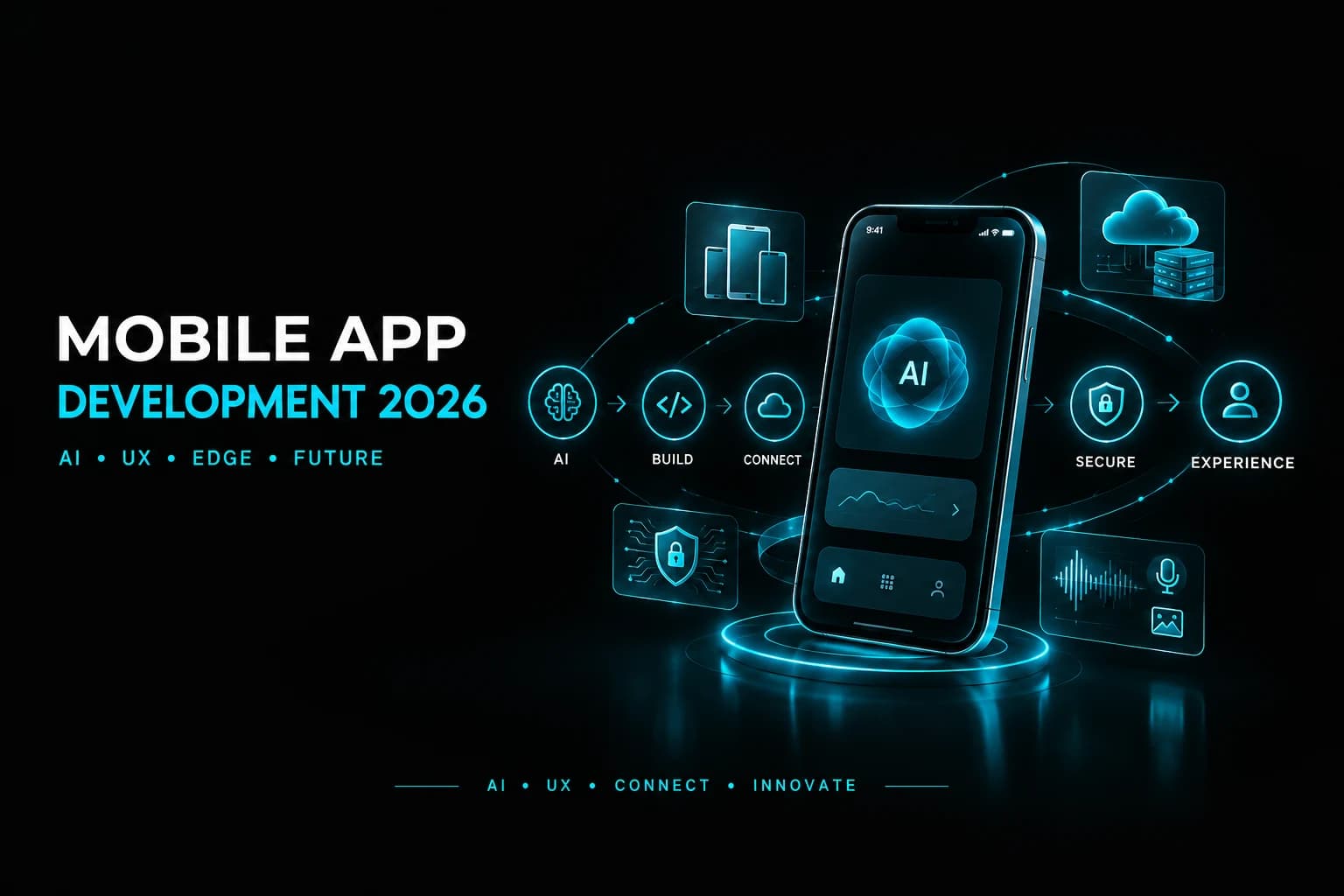
Mobile app development in 2026 is being reshaped by agentic AI, cross-platform frameworks, super apps, spatial computing, hyper-personalization, edge computing, privacy-first design, sustainable engineering, low-code development, and multimodal user experiences.
Key Takeaways
With the rise of agentic AI, machines can now handle the lifecycle and campaigns, but human oversight is essential.
Cross-platform is the default. Flutter, React Native, and Kotlin Multiplatform deliver near-native performance while reducing development time and maintenance overhead.
Super apps are becoming the new normal, merging payments, messaging, and commerce inside one unified experience.
Edge-native architecture enables real-time performance, ultra-low latency, and smarter offline handling through on-device processing.
Privacy-first design, secure engineering, and energy-efficient coding are becoming important standards of professional mobile development.
The Mobile App Development Shift in 2026
By the time you finish reading this article, new apps can appear in app stores worldwide. That pace says a lot about where the industry stands.
Building apps has never been easier or faster thanks to smarter tools, cross-platform frameworks, and AI that codes alongside developers.
The mobile application development trends defining 2026 revolve around this acceleration, where technology, design, and automation all move in sync.
The current trends show a clear pattern: teams are building faster, smarter, and with a sharper focus on experience.
2026 is the year of refinement: cleaner workflows, more automation, and tools that finally keep up with developer instincts.
1. Agentic AI and Generative Development
The first major trend in mobile app development is AI agents. Mobile teams can use AI agents to read repositories, fix dependencies, and keep Kotlin, Swift, and Flutter codebases aligned and consistent.
Design-to-code workflows are becoming more efficient. A Figma link or exported layout can be used to draft layouts, map components to a component library, and prepare work for review.
AI systems can also analyze telemetry, identify crash clusters, and help developers locate the commits responsible for problems.
The effect across teams is faster development cycles, fewer regressions, and calmer development workflows.
Agentic AI is moving beyond a simple trend and becoming an important part of modern mobile development.
2. Cross-Platform Development Becoming the Standard
One codebase for iOS and Android provides significant efficiency. In 2026, mobile teams are increasingly using frameworks such as Flutter, React Native, and Kotlin Multiplatform.
One shared module can handle business logic such as API calls, models, and state management.
Platform-specific shells can remain focused on UI adjustments, animations, and native integrations.
Tests can be run once and deployed across platforms, reducing bugs caused by inconsistent implementations.
For businesses, cross-platform development can reduce time-to-market, maintenance effort, and management overhead.
Performance trade-offs still exist, but they continue to shrink as frameworks improve. Multi-device and multi-screen experiences are also becoming an important expectation across phones, tablets, wearables, desktops, and in-car systems.
3. The Rise of Super Apps and Mini App Ecosystems
Super apps are moving beyond being associated with a particular region. In 2026, technology ecosystems are combining services that previously existed as separate products.
Messaging platforms can include payments, social feeds can become marketplaces, and mobility applications can combine transportation, food delivery, events, and other services.
Modern super apps use modular micro-frontends connected through secure APIs and message queues. Each mini app can operate independently while the parent platform manages authentication, data, and payment layers.
This architecture helps reduce feature sprawl. Instead of maintaining multiple disconnected applications, teams can extend one ecosystem with independently released modules.
Users experience continuity while developers can ship new services with less risk.
The model can increase engagement, create additional monetization opportunities, simplify cross-selling, and support third-party mini applications.
For teams planning a 2026 roadmap, super apps represent a move toward ecosystems where users can access multiple services inside one digital experience.
4. Spatial Computing and Mixed Reality
Spatial computing is becoming an important part of mobile development as interfaces expand beyond traditional screens.
Developers can experiment with immersive interfaces using devices such as Apple Vision Pro, Meta Quest, and emerging AR glasses.
Mobile logic and assets can increasingly be reused across different devices through shared SDKs and cross-platform tooling.
The interface changes from living only in pixels to existing in physical space. Examples include dashboards positioned in a user's environment, navigation overlays, and remote maintenance experiences combining video, 3D models, and AI assistance.
Spatial experiences also introduce new ways to measure UX through eye tracking, gesture capture, and depth mapping.
Healthcare, logistics, and education are among the areas where spatial experiences can support training, remote diagnostics, and other practical workflows.
For mobile developers, spatial computing creates a larger canvas where applications compete for presence rather than simply screen space.
5. Hyper-Personalization and Context-Aware UX
Personalization in 2026 goes beyond displaying different banners. Applications can dynamically adapt layouts, navigation, timing, and microcopy based on user context.
Motion sensors, geolocation, calendar data, and other contextual signals can influence application behavior.
Lightweight on-device models allow intelligence to run locally rather than depending entirely on cloud inference. This can improve speed, privacy, and battery efficiency.
The design process is shifting from static user journeys to adaptive states that react to user intent and context.
When implemented effectively, context-aware interfaces can reduce friction by providing fewer steps, better timing, and more relevant experiences.
Static interfaces are becoming less effective as applications increasingly adapt themselves to users and their environments.
6. Edge Computing and 5G-Native Mobile Architectures
Real-time performance is becoming a core requirement for mobile applications, and edge computing helps achieve it by processing data closer to users.
Instead of sending every operation to distant cloud infrastructure, computing tasks can be distributed to edge nodes, 5G infrastructure, local gateways, or the user's device.
This approach can reduce latency, improve streaming performance, and reduce unnecessary battery usage.
Applications such as logistics tracking, augmented reality, and industrial IoT can benefit from processing information closer to the source.
5G adds ultra-low-latency connectivity that can support experiences such as cloud gaming, real-time translation, and advanced video communication.
Developers are adopting edge-native principles by keeping critical logic close to the device while synchronizing long-term data with cloud systems.
Important engineering patterns include data partitioning, local inference, and event streaming.
The result is faster applications, smoother streaming, and more reliable experiences in areas with weak connectivity.
7. Privacy-First Design and Secure Engineering
In 2026, privacy-first design is becoming a core part of mobile product strategy rather than simply a compliance requirement.
Developers are integrating security into the development process instead of waiting until the end of the project.
Zero-trust architectures and privacy-preserving models are becoming common approaches in serious mobile projects.
Modern systems can use secure enclaves, differential privacy, and federated learning to protect data while supporting intelligent functionality.
Security can also be integrated into SDKs and CI/CD workflows through static code analysis, secrets management, and runtime threat detection.
Privacy also affects UX. Transparent consent flows, contextual permission prompts, and clear data-usage information can help users understand how their information is handled.
Privacy-first applications can strengthen user trust while reducing the risks associated with data exposure.
8. Sustainable Software Engineering and Green Coding
Energy efficiency has become an important software engineering consideration. Teams are increasingly monitoring application power usage, optimizing APIs, and reducing unnecessary computation.
Developers are considering energy consumption at the feature level. Heavy animations, constant polling, and oversized libraries can all create unnecessary resource usage.
Efficient APIs, optimized code, and better resource management can reduce both computing requirements and operational costs.
AI inference is also becoming more efficient through quantized, distilled, and edge-optimized models.
Small optimizations can have a significant impact when applications operate at large scale.
Sustainable engineering is not simply about environmental responsibility. Efficient software can also improve performance, reduce resource consumption, and lower infrastructure costs.
Green engineering is increasingly becoming part of modern software design and development practices.
9. Low-Code and No-Code Acceleration
Low-code and no-code platforms have evolved into serious productivity tools for modern development teams.
Teams can use visual development platforms to create internal dashboards, quick MVPs, and production workflows.
Product managers can design workflows in visual builders while developers add custom logic or connect those workflows to broader application architectures.
Quality assurance teams can run automated tests while the development process remains integrated with existing delivery workflows.
Visual development can handle routine CRUD operations while custom code focuses on scalability, security, and complex edge cases.
AI-assisted low-code tools add another layer by generating functions, suggesting UI layouts, and creating integration scripts from natural-language prompts.
The goal is not to replace developers but to reduce repetitive work and allow engineering teams to focus on higher-value problems.
10. Conversational Interfaces, Multimodal UX and Conclusion
Touchscreens remain important, but voice, gestures, and glance-based interactions are becoming increasingly significant in mobile applications.
Users are beginning to expect applications to understand voice commands, support message dictation, and assist with tasks without requiring traditional touch interactions for every action.
Developers must design for multiple input types, including microphones, cameras, sensors, gestures, and touch.
The real power comes from combining different interaction methods. A user might begin a task using voice, adjust details with a gesture, and confirm the action with a tap.
Multimodal UX can also improve accessibility by adapting application interactions to different abilities and environments.
Mobile app development in 2026 is becoming an orchestration of AI, edge-native systems, cross-platform development, privacy, personalization, sustainability, and multimodal experiences.
The best teams build with intent. They automate routine tasks, personalize experiences, improve efficiency, and make every feature earn its place.
For anyone planning their next product cycle, 2026 is a year to build with clarity. Focus on ecosystems, intelligence, efficiency, privacy, and long-term value. This mindset can turn good applications into benchmarks for the industry.