
 n
nAndroid App Development Trends Every Business Should Know
The future of Android development is intelligent, scalable, and privacy-focused. Explore the key technologies and trends helping businesses create next-generation mobile experiences in 2026.
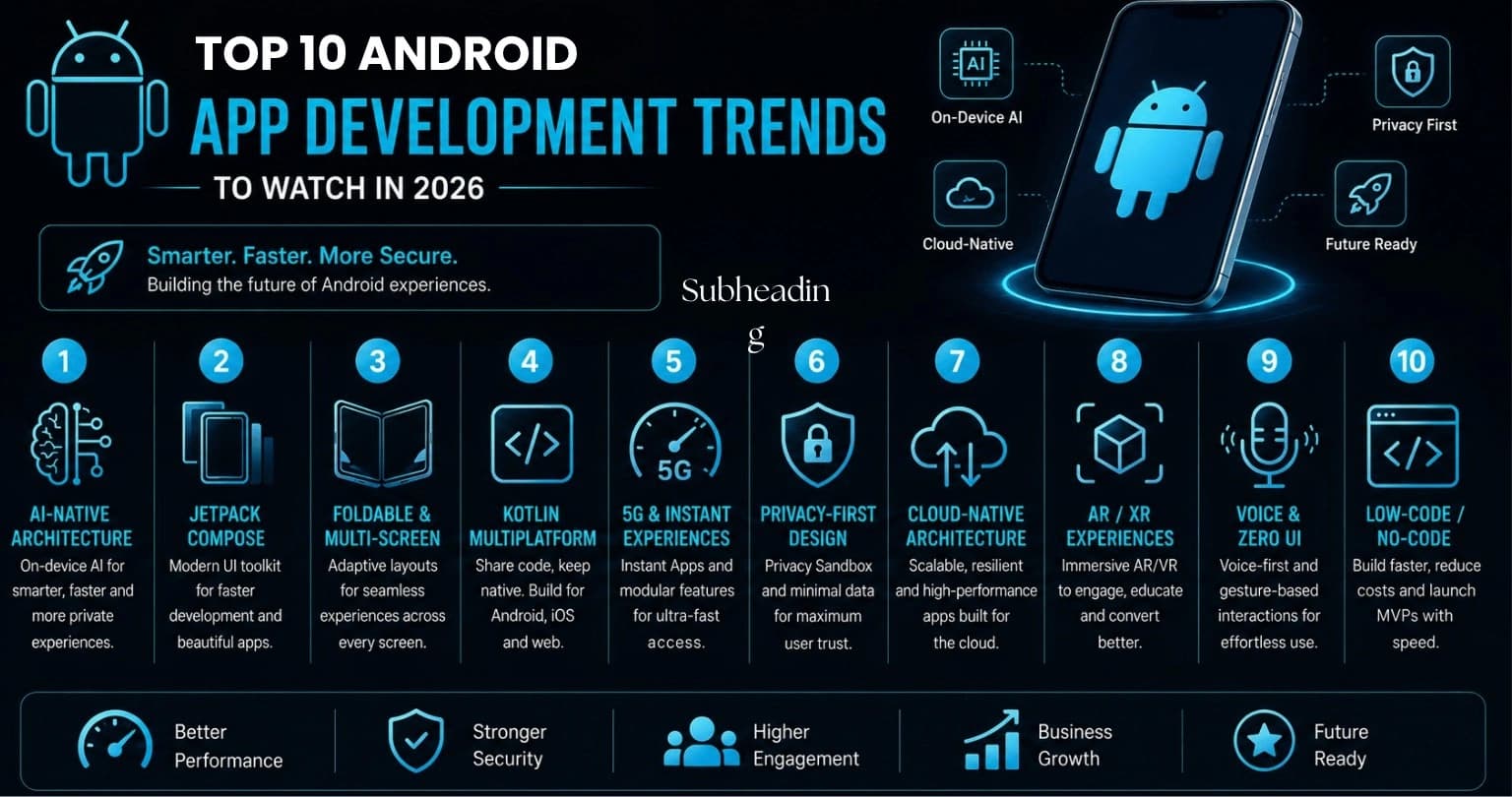
Introduction
Android holds the largest global smartphone market share, making it the most critical platform for reaching mass audiences. In 2026, the Android ecosystem is defined by on-device AI, foldable-ready interfaces, privacy-first design, and cloud-native architecture. Businesses that adopt these trends gain better performance, stronger security, and higher user engagement—while those that lag risk losing competitive edge. Below are the key Android app development trends every business should prioritize this year.
1. AI-Native Architecture and On-Device Intelligence
The biggest shift in 2026 is moving from "AI-enabled" to "AI-native" apps. Modern smartphones now include powerful neural processing units (NPUs) that run models like Google's Gemini Nano directly on the device, enabling real-time personalization, smart predictions, and instant translations without cloud latency. This improves privacy (data stays on-device), reduces response time, and allows apps to adapt UI dynamically based on user behavior.
2. Jetpack Compose as the Default UI Toolkit
Jetpack Compose has replaced XML layouts as Android's standard UI framework. Its declarative approach reduces boilerplate code, accelerates development, and enables faster shipping of features with fewer bugs. Over 60% of the top 1,000 Play Store apps—including Airbnb, Hotstar, Dropbox, and Pinterest—now use Compose. It also supports adaptive layouts essential for foldable devices and=edge-to-edge design requirements in modern Android versions.
3. Foldable and Multi-Screen Optimization
Foldable phones and dual-screen devices have reached mass-market adoption in 2026. Successful apps now seamlessly transition between "folded" (phone) and "unfolded" (tablet) states using adaptive layouts and window size classes in Jetpack Compose. Apps like Microsoft Office, Notion, Kindle, and Canva have optimized UI for flexible screen dimensions and multitasking—ignoring this trend means missing a premium user segment.
4. Kotlin Multiplatform (KMP) for Shared Logic
Kotlin Multiplatform (KMP) allows teams to write core business logic, networking, and data storage code once in Kotlin and share it across Android, iOS, and web while keeping native UIs (Compose on Android, SwiftUI on iOS). Brands like McDonald's, Netflix, Philips Hue, and Forbes use KMP to reduce development costs while maintaining native performance. This is now the preferred approach for companies building cross-platform products.
5. 5G-Enabled Experiences and Instant Apps
With 5G networks now ubiquitous, Android Instant Apps have been revitalized. Users can stream feature-rich app modules without installing anything—perfect for e-commerce product configurators, gaming demos, and onboarding flows. This frictionless experience drives higher conversion rates and pushes developers to modularize codebases into smaller, on-demand features that load quickly over high-bandwidth networks.
6. Privacy Sandbox and Privacy-by-Design
Google's Privacy Sandbox on Android is now fully operational, fundamentally changing how advertising and analytics work. Third-party cookie tracking is gone; instead, privacy-preserving APIs aggregate data without revealing individual identities. Businesses must adopt privacy-by-design: request fewer permissions, explain why they're needed, and comply with evolving regulations like GDPR. Users in 2026 are tech-savvy and will uninstall apps that overreach.
7. Cloud-Native Architecture and Scalability
Cloud-native Android development is essential for building high-performance, scalable applications. Integrating cloud services enables user authentication, cross-platform access, real-time updates, and data synchronization while reducing device load and boosting speed. Experts predict 95% of new digital workloads will shift to cloud-native architecture by end-2026, with companies like Walmart, Airbnb, and Discord already adopting this approach.
8. Augmented Reality (AR) and Extended Reality (XR)
AR and XR are transforming industries like retail, real estate, education, and healthcare. Apps like IKEA Place, Google Maps AR, and Google Lens let users visualize products in their space, navigate streets with overlay directions, or identify objects instantly. These immersive experiences drive engagement and differentiation—especially for shopping, where users can "try before they buy" virtually.
9. Voice-Based Interfaces and Zero UI
Voice assistants are now mainstream, making voice-based interfaces a must-have feature. Apps like YouTube, Spotify, Instagram, and eBay integrate voice navigation for hands-free interaction, making conversations with virtual assistants feel natural. Zero UI—where interactions happen through voice, gestures, or context rather than taps—is redefining Android UX and improving accessibility.
10. Low-Code/No-Code Development for Speed
Low-code and no-code platforms (Adalo, Glide, Mendix, FlutterFlow) enable rapid app development with drag-and-drop functionality, reducing time-to-market and costs. 4 out of 5 businesses in the US now use low-code platforms, and 84% adopt them to address developer shortages. This trend is ideal for startups, MVPs, and internal tools, though complex products still benefit from custom development.
Conclusion
The Android landscape in 2026 is smarter, faster, and more fragmented than ever. To stay competitive, businesses must prioritize AI-native architecture, Jetpack Compose UI, foldable optimization, Kotlin Multiplatform, 5G-enabled instant apps, privacy-first design, cloud-native scalability, AR/XR immersion, voice interfaces, and low-code speed. Start by auditing your current app against these trends—prioritize quick wins like Compose migration and privacy compliance, then plan longer initiatives like AI integration and foldable support. Investing in these technologies today ensures your Android app delivers the premium, feature-rich experience users expect tomorrow.